Executive Summary
As medical diagnostics and wearables shrink, traditional through-hole vias become major bottlenecks for signal routing and routing density. High-Density Interconnect (HDI) technology solves this via sequential lamination and laser-drilled microvias. This whitepaper analyzes the mechanical limits, plating physics, and thermal reliability criteria required to manufacture medical-grade HDI boards up to Any-Layer ELIC configurations.
1. Deconstructing Sequential Lamination: From 1+N+1 to Any-Layer ELIC
HDI complexity is fundamentally classified by the number of sequential lamination cycles. A standard 1+N+1 architecture indicates a single conventional sub-stack core (N layers) laminated once, followed by a single laser-drilled microvia layer on the top and bottom surfaces. When outer-layer density requires overlapping connections, designs escalate to 2+N+2 (stacked or staggered microvias) or ultimately to Any-Layer ELIC (Every Layer Interconnect).
In Any-Layer ELIC, every single copper transition layer consists of laser microvias, allowing total layout freedom for ultra-dense BGA pitches (<0.4mm) found in next-generation clinical patches. However, each lamination cycle subjects the inner core to additional thermal excursions. At JS Circuit, we utilize premium high-Tg materials to minimize cumulative thermal deformation and delamination risks.
Table 1: Standard Structural Breakdown of a 1+4+1 6-Layer HDI Stackup
| Layer ID | Type | Material Specification | Via Connectivity Range |
|---|---|---|---|
| L1 (Top) | Signal (Outer Foil) | 1/3 oz Cu base (Finished ~1oz) | L1 → L2 (Laser Microvia) |
| Dielectric | Prepreg (PP) | 1x Prepreg 1080 (High-Tg, Dk=4.1) | – |
| L2 | Ground Plane | 1 oz Inner Copper | L2 → L5 (Mechanical Buried Via) |
| Dielectric | Sub-Core Board | FR-4 Rigid Core (Isola 370HR) | – |
| L3 | Signal / Routing | 1 oz Inner Copper | L2 → L5 (Mechanical Buried Via) |
| Dielectric | Inner Prepreg | Prepreg 2116 (High-Tg FR-4) | – |
| L4 | Power Plane | 1 oz Inner Copper | L2 → L5 (Mechanical Buried Via) |
| Dielectric | Sub-Core Board | FR-4 Rigid Core (Isola 370HR) | – |
| L5 | Ground Plane | 1 oz Inner Copper | L2 → L5 (Mechanical Buried Via) |
| Dielectric | Prepreg (PP) | 1x Prepreg 1080 (High-Tg, Dk=4.1) | – |
| L6 (Bot) | Signal (Outer Foil) | 1/3 oz Cu base (Finished ~1oz) | L6 → L5 (Laser Microvia) |
2. The Physics of Laser Microvias: Diameter and Aspect Ratio Constraints
Unlike mechanical drills that easily penetrate thick sub-cores, laser drilling (CO2 or UV lasers) is governed by tight geometry limitations. To be considered a true microvia according to IPC-T-50 standards, the target diameter must be ≤0.15mm (typically 75μm–100μm in advanced nodes).
The core manufacturing metric is the Aspect Ratio (AR), defined as the microvia depth divided by its hole diameter. For maximum structural durability, the industry standard mandates an Aspect Ratio ≤ 1:1 (optimally 0.75:1 to 0.8:1). If the AR exceeds 1:1, acid copper plating chemistries cannot easily refresh inside the blind pocket. This results in weak knee plating or voids, which fail catastrophically under the thermal shock testing common in medical quality validation.
3. Copper Plating Mechanics & VIPPO Implementation
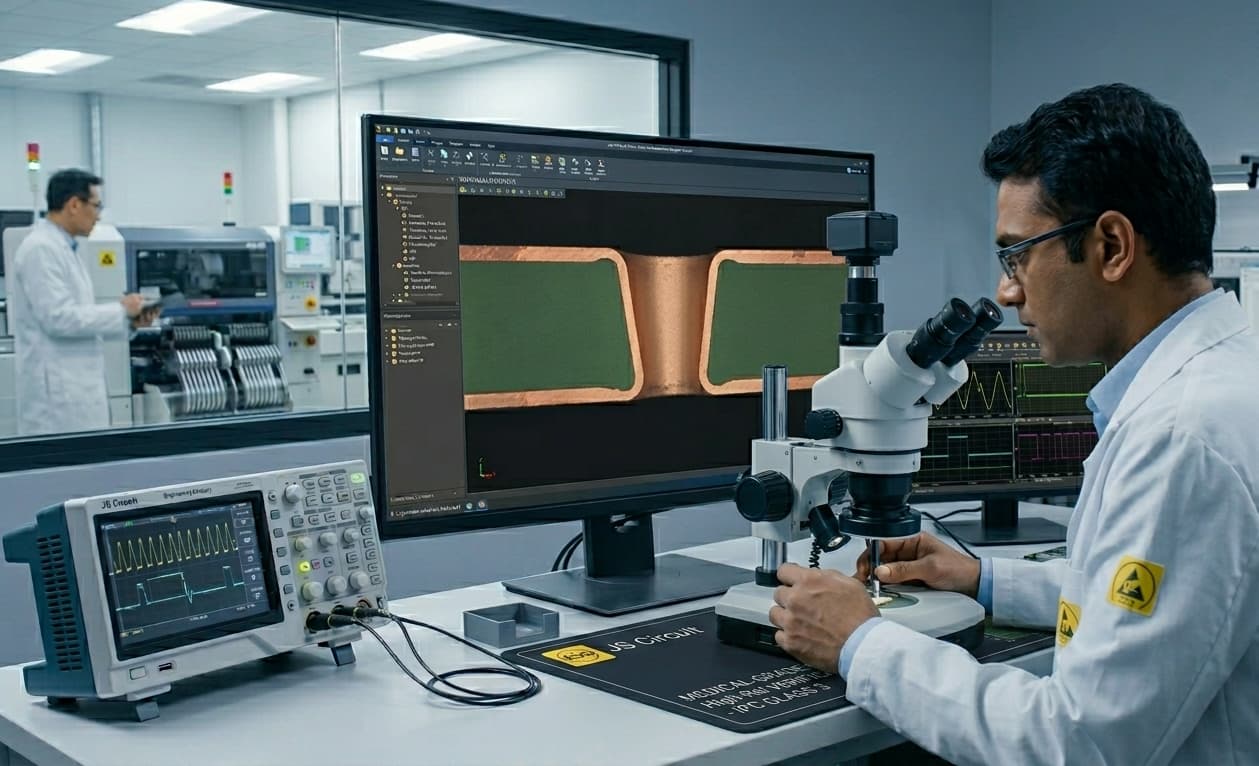
Once blind microvias are blasted, they undergo VCP (Vertical Continuous Plating) copper filling. Unlike traditional through-holes that only require conformal barrel wall plating, microvias require super-filling chemistry to completely pack the blind pocket with solid copper. Any internal voiding creates trapped outgassing pockets during reflow, pushing the target pad upward.
For fine-pitch components, these vias are located directly within the BGA surface lands—a technique known as Via-in-Pad (VIPPO: Via-in-Pad Plated Over). VIPPO requires a non-conductive epoxy plug after core through-hole drilling, planarization, and subsequent over-plating with flat copper. This yields an entirely co-planar surface pad, preventing solder thieves and guaranteeing zero component tilt during assembly. This extreme level of care mirrors our strict guidelines on medical manufacturing reliability.
Frequently Asked Questions (FAQ)
Q1: Why choose stacked microvias over staggered microvias?
Stacked vias maximize real estate by saving massive surface area. However, because they create localized z-axis stress, they require robust VCP filling. Staggered vias are mechanically safer but require offset space, slightly decreasing overall routing density.
Q2: What is “Microvia ICD” and how does JS Circuit prevent it?
ICD (Inner Layer Connection Defect) occurs when resin residue separates the target layer from the copper plating. We enforce aggressive chemical desmear and plasma treatment processes before VCP to guarantee absolute molecular bonding between the microvia base and inner landing pad.
Q3: Does using thin prepregs for low AR affect impedance?
Yes. Thinner prepregs bring trace layers closer to reference grounds, which reduces track impedance. To maintain a standard 50-Ohm single-ended target, trace widths must shrink accordingly. Our layout engineering evaluates this balance during initial pre-lamination reviews.
Bring Precision to Your High-Density Medical Designs
Whether you require complex 2+N+2 stackups or Any-Layer ELIC medical wearables, JS Circuit provides industry-leading manufacturing tolerances with 100% automated optical inspection.