HDI Printed Circuit Boards
consist of a single copper conductor layer on a flexible dielectric film . Single-sided circuits can be fabricated with or without cover layers.
HDI PCB Manufacturer In China
Single-layer flexible circuits consist of a single copper conductor layer laminated onto a flexible dielectric film, such as polyimide or polyester. The circuit can be supplied with or without a coverlay, depending on the insulation and environmental protection requirements of the end application.
This simple, cost-effective structure is ideal for dynamic interconnections, hinge areas, and space-constrained designs, offering excellent bendability, low weight, and easy integration into consumer electronics, automotive modules, LED lighting, medical devices, and industrial control systems.
Detailed Specification
| Item | Value |
|---|---|
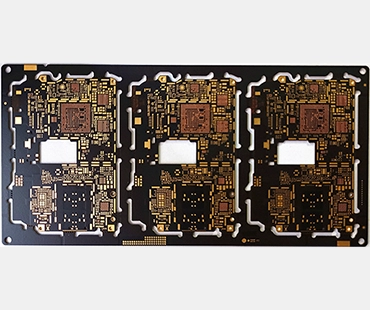
| Application Field | Smartphone |
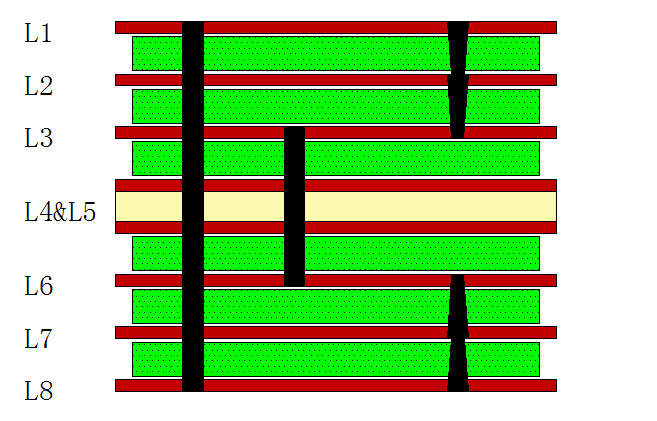
| Layer Count | 8 (2+4+2) |
| Board Thickness | 0.69 ±10% mm |
| Line Width / Space | 0.075 / 0.05 mm |
| Lamination | EMC EM-285 |
| Aspect Ratio | 3.1073 |
| Surface Treatment | ENIG + OSP |
Different Types of HDI PCB
HDI PCB Design
Key Features of High-Density Interconnect (HDI) PCBs
HDI PCBs feature microvias, blind and buried vias, and fine line/space capability, allowing dense component placement and short signal paths. Using thin dielectric materials and multi-step lamination, HDI stack-ups can integrate high-speed signal layers, power/ground planes, and BGA escape routing within a very limited board area.
Compared with standard multilayer boards, HDI designs offer better signal integrity, lower crosstalk, and reduced propagation delay, especially for high-frequency and high-speed interfaces. They support advanced packages such as micro-BGA, CSP and flip-chip, and are fully compatible with modern SMT assembly, reflow soldering and automated testing, providing a robust platform for next-generation electronic products.
Typical Applications of HDI PCBs in Advanced Electronics
HDI PCBs are widely used in smartphones, tablets, wearables and consumer electronics, where ultra-compact layouts and high I/O density are required. They provide reliable interconnection for application processors, memory, RF modules and camera systems, enabling thin, lightweight end products.
In networking, automotive, industrial and medical electronics, HDI technology supports complex control units, radar and ADAS modules, high-speed communication boards, imaging systems and compact control modules. Wherever designers need to combine small form factor, high functionality and stable high-speed performance, HDI PCBs have become the preferred interconnect solution.