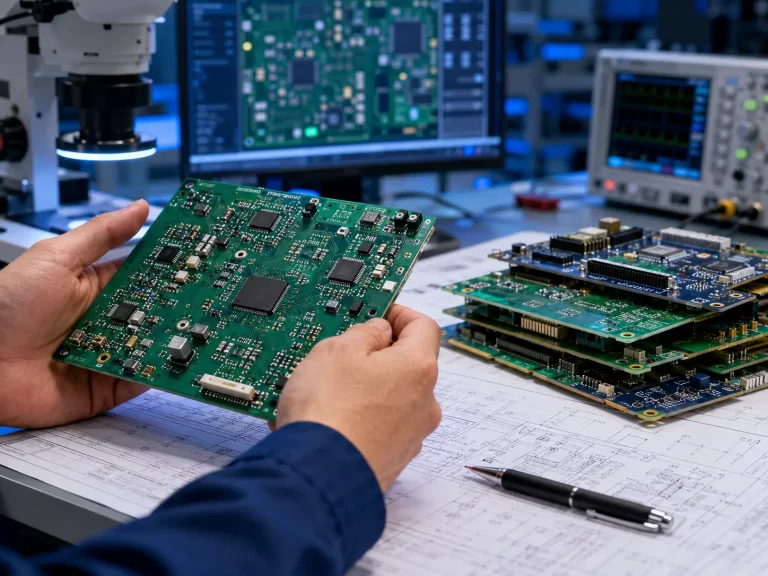
A hardware team is designing a compact medical sensor. The enclosure is small, the BGA package is fine-pitch, the signal paths must stay short, and the board area is already crowded before routing even begins. A standard multilayer PCB may look cheaper at first, but the layout quickly becomes a maze of blocked routing channels, oversized vias, impossible escape paths, and signal integrity risk. This is where HDI PCB becomes more than an advanced option. It becomes a design necessity.
Modern electronics are getting smaller, faster, lighter, and more integrated. Smartphones, wearables, automotive modules, medical devices, drones, telecom equipment, and industrial controllers all push PCB density higher. Buyers reviewing HDI PCB manufacturing solutions should understand that HDI is not simply “more layers.” It is a design and manufacturing approach built around microvias, finer traces, advanced stack-ups, sequential lamination, controlled impedance, and tighter process control.

What Is an HDI PCB?
HDI PCB Explained in Practical Engineering Terms
HDI PCB means High-Density Interconnect Printed Circuit Board. It uses smaller vias, finer line width and spacing, higher interconnection density, laser-drilled microvias, blind vias, buried vias, and advanced layer structures to support compact and high-performance electronic products. Compared with a conventional PCB, HDI allows more routing channels in less board area.
The key value of HDI is routing efficiency. When a design includes fine-pitch BGA, high-pin-count ICs, dense connectors, compact modules, or high-speed routing requirements, conventional through-hole vias may consume too much space. HDI uses microvias and build-up layers to free routing areas and reduce unnecessary board size. For a deeper product-level explanation, buyers can review what is an HDI PCB before finalizing the design direction.
HDI PCB vs. Standard Multilayer PCB
A standard multilayer PCB often relies more heavily on mechanical drilling and through-hole vias. It can work very well for low-density layouts, larger components, lower-speed signals, and cost-sensitive electronics. HDI PCB is different because it uses microvias, laser drilling, sequential lamination, finer line/space, and more complex interconnection structures.
The decision should not be emotional. Do not choose HDI just because it sounds advanced. Choose HDI when it solves a real design problem: limited space, fine-pitch BGA escape, high routing density, signal path optimization, or product miniaturization. If the board has enough space and routing is simple, a standard PCB may be more practical.
| PCB Type | Via Structure | Routing Density | Best Application | Buyer Recommendation |
|---|---|---|---|---|
| Standard multilayer PCB | Mostly through-hole vias | Medium | General electronics and lower-density layouts | Choose when board space is enough and routing is simple. |
| HDI PCB | Microvias, blind vias, buried vias | High | Fine-pitch BGA, compact modules, dense electronics | Choose when density, space, and routing performance matter. |
| High-speed HDI PCB | Microvias with controlled impedance structures | Very high | 5G, telecom, RF, radar, high-speed digital systems | Confirm stack-up, material Dk/Df, and impedance capability early. |
Why Engineers Choose HDI PCB
Smaller Size and Higher Component Density
The most obvious reason to choose HDI PCB is miniaturization. Microvias use less space than conventional through vias, allowing more routing channels between dense components. Fine-pitch BGA packages often require microvia escape routing because traditional vias may be too large to fit efficiently between pads.
If the product is a wearable device, camera module, medical sensor, drone controller, compact IoT module, or smartphone accessory, reducing board area may directly improve product design. Buyers comparing the key advantages of HDI PCB in compact devices should focus on both physical miniaturization and routing freedom. Smaller board size is nice. Making the layout actually manufacturable is even nicer.
Shorter Signal Paths and Better Electrical Performance
HDI can reduce trace length, via stub length, and unnecessary routing detours. Shorter interconnects may improve signal integrity, especially in compact high-speed designs. Microvias can reduce parasitic inductance compared with long through vias, while optimized stack-up design can improve return paths, impedance control, EMI behavior, and power distribution.
However, HDI is not automatic magic. Poor stack-up, wrong dielectric thickness, uncontrolled trace geometry, or poorly designed reference planes can still create signal problems. The real benefit appears when HDI routing, layer stack-up, impedance design, and manufacturing capability are planned together.
Support for Fine-Pitch BGA and Advanced IC Packages
Fine-pitch BGA, CSP, and high-pin-count IC packages are common in compact electronics. These components can make routing difficult because the available escape channels are limited. HDI allows microvias, blind vias, and via-in-pad structures to route dense pin arrays without excessively increasing board size or layer count.
If a conventional layout cannot escape the BGA without pushing the board larger, adding more layers, or violating design rules, HDI may be the correct solution. If the component pitch is relaxed and routing is easy, HDI may not be necessary. That is the buyer logic: choose HDI when it solves routing density, not when a brochure makes it sound fancy.
HDI PCB Stack-Up Design
What Is HDI Stack-Up?
Stack-up defines the arrangement of copper layers, dielectric materials, prepreg, core, ground planes, power planes, and via structures. In HDI PCB design, stack-up planning is critical because microvias and build-up layers must be aligned with routing needs, signal integrity, board thickness, manufacturability, and reliability.
Common HDI structures include 1+N+1, 2+N+2, and any-layer HDI. The “N” refers to the core multilayer board, while the numbers on each side refer to build-up layers. More build-up layers provide more routing freedom but increase manufacturing cost, lamination cycles, registration challenges, and process risk. Buyers should discuss advanced HDI PCB stack-up and microvia technology with the manufacturer before layout is locked.
Common HDI Stack-Up Types
| Stack-Up Type | Structure Meaning | Typical Use | Complexity | Buyer Recommendation |
|---|---|---|---|---|
| 1+N+1 HDI | One build-up layer on each side of the core | Moderate-density designs | Medium | Suitable when limited microvia routing is needed. |
| 2+N+2 HDI | Two build-up layers on each side | Dense BGA and compact modules | High | Use when fine-pitch routing is dense on both sides. |
| Any-layer HDI | Microvia connections across multiple layer combinations | Extremely compact high-density electronics | Very high | Use only when density requires it and budget allows. |
How to Choose the Right HDI Stack-Up
If the design only needs limited microvia escape routing, 1+N+1 may be enough. If the design includes dense fine-pitch BGA on both sides, 2+N+2 may be more suitable. If the product is extremely compact, high-performance, and space-limited, any-layer HDI may be required. However, every extra lamination step increases cost and risk.
If controlled impedance matters, stack-up must be planned with dielectric thickness, copper weight, material Dk, target impedance, and reference plane position in mind. If the stack-up is considered too late, redesign is likely. And redesign is the PCB world’s polite way of saying, “We should have talked to the factory earlier.”

Microvias, Blind Vias, Buried Vias, and Via-in-Pad
Microvias in HDI PCB
Microvias are small vias typically produced by laser drilling. They usually connect adjacent layers or build-up layers and are essential for high-density routing. Microvias save routing space, support fine-pitch component escape, and reduce the need for large through vias across the whole board.
Microvia reliability depends on geometry, aspect ratio, copper plating quality, via filling, lamination control, and thermal stress behavior. Stacked microvias can increase density but may introduce reliability concerns if not manufactured correctly. Staggered microvias may be a safer option in some designs. Buyers should not treat microvias as just small holes. They are small holes with very big consequences.
Blind Vias and Buried Vias
Blind vias connect an outer layer to one or more inner layers without passing through the full board. Buried vias connect internal layers and are not visible from the outside. Both improve routing density, but they require additional drilling, lamination, and process control. The more via types a design includes, the more important manufacturer capability becomes.
Via-in-Pad for Fine-Pitch Components
Via-in-pad places the via directly in the component pad. It is often used for fine-pitch BGA and compact component layouts. This structure may require via filling, copper capping, planarization, and a suitable surface finish to prevent solder wicking and assembly defects.
| Via Type | Function | Benefit | Risk if Poorly Designed |
|---|---|---|---|
| Through via | Connects top to bottom through the board | Simple and reliable for standard routing | Consumes routing space and may create via stubs. |
| Blind via | Connects outer layer to inner layer | Improves routing density | Requires accurate drilling and lamination control. |
| Buried via | Connects internal layers only | Keeps outer layers available for routing | Adds process complexity. |
| Via-in-pad | Places via inside component pad | Supports fine-pitch BGA routing | Poor filling can cause soldering defects. |
Materials Used in HDI PCB
Core Material Parameters Buyers Should Confirm
Material selection affects HDI PCB reliability, signal performance, thermal stability, lamination behavior, and cost. Buyers should confirm Tg, CTE, Dk, Df, copper thickness, dielectric thickness, resin system, moisture absorption, CAF resistance, halogen-free requirements, thermal conductivity, and flammability rating such as UL 94 V-0 where applicable.
For general HDI products, high-Tg FR-4 may be enough. For RF, 5G, radar, telecom, or high-speed digital systems, low-loss materials may be required. Over-specifying expensive materials can waste budget, but under-specifying materials can cause delamination, impedance drift, high insertion loss, or field reliability issues. Both mistakes are expensive; one is just quieter at the beginning.
FR-4, High-Tg FR-4, and High-Speed Materials
| Material Type | Typical Use | Key Benefit | Limitation | Buyer Recommendation |
|---|---|---|---|---|
| Standard FR-4 | General electronics | Cost-effective and widely available | Limited for high thermal or high-speed demands | Use for moderate HDI applications if performance allows. |
| High-Tg FR-4 | Thermally demanding multilayer boards | Better thermal stability | Higher cost than standard FR-4 | Use for higher layer count and reliability-sensitive designs. |
| Low-loss laminate | RF, 5G, telecom, radar, high-speed digital | Lower signal loss and better impedance stability | Material cost and processing complexity | Use when signal speed or frequency requires it. |
Copper Thickness and Line/Space Capability
HDI boards often use fine traces and tight spacing. Copper thickness affects current capacity, etching tolerance, impedance, and manufacturability. Very fine line/space requires strong process control. Heavier copper can make fine pattern etching more difficult. Designers should confirm the manufacturer’s minimum line/space capability before layout finalization.
HDI PCB Design Rules
Minimum Line Width and Spacing
Fine line/space enables high-density routing, but it also increases manufacturing difficulty. Designers should avoid pushing minimum rules everywhere unless necessary. Relaxed design rules in non-critical areas can improve yield and reduce cost. Critical nets may require controlled impedance and tighter constraints, while lower-speed nets may not need aggressive geometry.
Microvia Aspect Ratio and Reliability
Microvia geometry affects plating quality and reliability. Deep, narrow microvias are harder to plate consistently. Stacked microvias may increase stress concentration during thermal cycling. Staggered microvias may improve reliability in some designs. For high-reliability applications such as automotive, medical, aerospace, and industrial systems, microvia reliability should be reviewed carefully.
Controlled Impedance and High-Speed Design
High-speed HDI PCB requires controlled impedance planning. Trace width, dielectric thickness, copper thickness, material Dk, reference planes, and differential pair spacing all influence impedance. Poor impedance control can cause signal reflection, EMI problems, data errors, and unstable product behavior. If impedance matters, the stack-up and impedance model should be developed before routing.

HDI PCB Manufacturing Process
Main Manufacturing Steps
HDI PCB manufacturing generally includes material preparation, inner layer imaging, etching, AOI inspection, lamination, laser drilling, mechanical drilling if required, desmear and cleaning, electroless copper deposition, copper plating, pattern plating, via filling, outer layer imaging, solder mask, surface finish, electrical testing, final inspection, and packaging.
Each process step must be controlled carefully. Laser drilling affects microvia geometry. Plating affects via reliability. Lamination affects registration and dielectric integrity. Surface finish affects assembly quality. Electrical testing catches opens and shorts, but it cannot fully replace good design and process control.
Sequential Lamination and Laser Drilling
HDI often requires sequential lamination. Each build-up layer may require laser drilling, cleaning, plating, and inspection. More lamination cycles mean higher cost and more registration risk. Laser drilling quality affects microvia reliability, and copper plating must be strong enough to survive assembly and field use.
Surface Finishes for HDI PCB
| Surface Finish | Best Use | Advantage | Risk | Buyer Recommendation |
|---|---|---|---|---|
| ENIG | Fine-pitch assembly and BGA | Flat surface and good solderability | Process control is important | Common choice for HDI and fine-pitch products. |
| OSP | Cost-sensitive lead-free assembly | Flat and economical | Limited shelf life and handling sensitivity | Use when assembly process is well controlled. |
| ENEPIG | High-reliability or wire bonding applications | Strong solderability and bonding support | Higher cost | Use when reliability or bonding requirements justify it. |
HDI PCB vs. Conventional PCB: When Should Buyers Upgrade?
When HDI PCB Is the Right Choice
Choose HDI PCB if the design includes fine-pitch BGA, high component density, limited board area, high-speed signals, compact modules, or advanced packaging. Choose HDI if conventional through vias block routing channels or if product size reduction has commercial value. For medical electronics, compact sensors, 5G modules, and automotive electronic units, HDI may be essential for both density and performance.
For a practical comparison, buyers can review HDI PCB vs standard rigid PCB when deciding whether microvias, fine-pitch routing, and medical-grade density justify the added manufacturing complexity.
When Standard PCB May Be Better
Use a standard multilayer PCB if board space is enough, routing is simple, components are not fine-pitch, signal speed is moderate, and cost control matters more than miniaturization. Unnecessary HDI can increase cost, extend lead time, complicate fabrication, and introduce avoidable reliability concerns. Advanced technology is useful only when the design actually needs it. Otherwise, it is just expensive decoration with copper inside.
| Design Situation | HDI PCB Needed? | Reason | Recommendation |
|---|---|---|---|
| Fine-pitch BGA | Often yes | Needs dense escape routing | Use microvias or via-in-pad if required. |
| Simple LED board | Usually no | Routing is simple | Use standard PCB unless density requires HDI. |
| Wearable device | Often yes | Small area and dense components | Consider 1+N+1 or 2+N+2 HDI. |
| 5G module | Yes | High-speed and compact routing | Confirm low-loss material and impedance control. |
Application Areas of HDI PCB
Consumer Electronics and Wearables
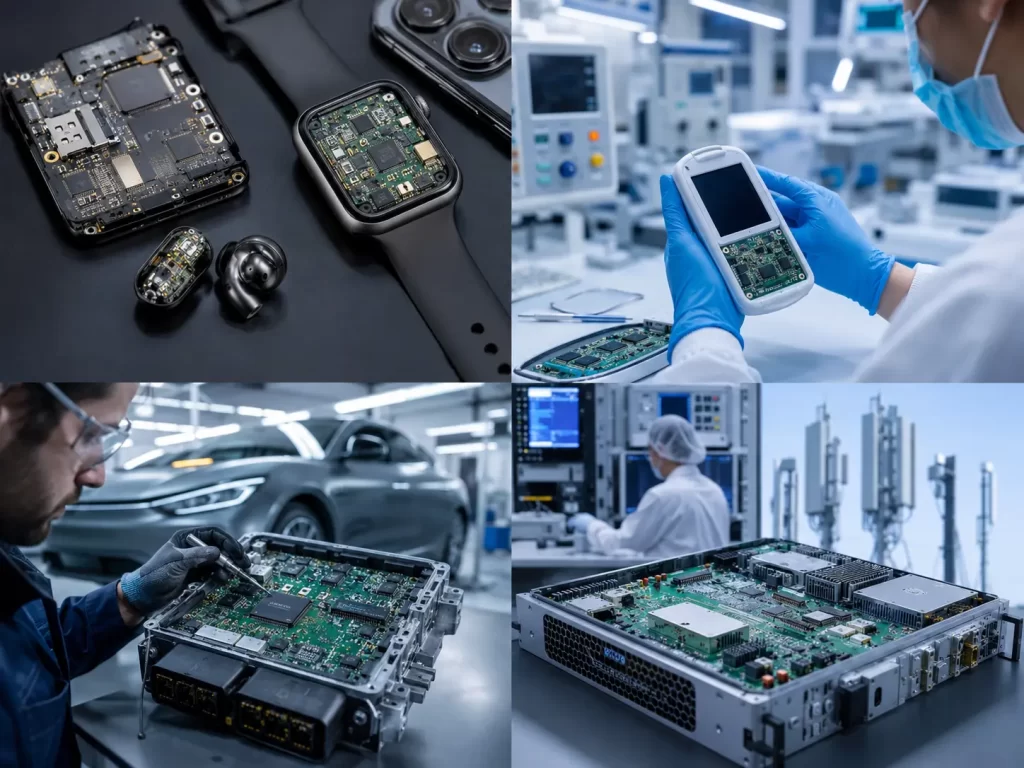
Smartphones, smartwatches, earbuds, compact cameras, and sensors use HDI because they need small size, light weight, and dense interconnects. HDI helps engineers place more function into less board area without routing chaos.
Medical Devices
Portable monitors, diagnostic devices, sensor modules, imaging systems, and wearable medical electronics often need compact boards and high reliability. Documentation, cleanliness, material traceability, and stable manufacturing control may be important depending on product risk level.
Automotive Electronics
ADAS modules, control units, radar systems, infotainment boards, lighting control, and battery management systems may use HDI when density and reliability requirements are high. Automotive buyers should pay attention to temperature cycling, vibration, traceability, PPAP-related needs, and manufacturer quality systems.
Telecom and 5G Systems
Telecom and 5G applications may require controlled impedance, low-loss laminate, RF routing, tight tolerances, and stable material properties. In these projects, HDI PCB manufacturing must be evaluated together with signal integrity and material selection.
Regulations, Standards, and Quality Requirements
IPC Standards for HDI PCB
Relevant standards may include IPC-2226 for HDI design guidance, IPC-6016 for HDI performance specifications, IPC-A-600 for PCB acceptability, IPC-6012 for rigid PCB qualification and performance, IPC-TM-650 test methods, and IPC-4101 for base material specifications. Buyers should also confirm IPC class requirements based on product application.
Automotive, Medical, and Export Requirements
Automotive buyers may require quality systems, traceability, reliability testing, and PPAP-related documentation. Medical electronics buyers may need stricter documentation and process control. Export products may require RoHS, REACH, UL, lead-free assembly compatibility, and material declarations. These requirements should be discussed before quoting, not after production starts.
Reliability Testing for HDI PCB
Useful testing and inspection methods include electrical test, AOI, X-ray inspection, microsection analysis, thermal cycling, solder float testing, peel strength testing, ionic contamination testing, impedance testing, CAF testing where required, and microvia reliability evaluation. For high-reliability designs, microsection analysis can be especially important because it reveals plating quality and via structure quality.
Common HDI PCB Manufacturing Defects and Risks
Microvia Plating Failure
Microvia plating failure can cause open circuits, intermittent failures, or thermal cycling failures. It may result from poor laser drilling, insufficient cleaning, poor copper deposition, weak plating, or unsuitable via geometry. Prevention includes proven aspect ratios, reliable plating processes, cross-section inspection, and reliability testing.
Misregistration Between Layers
Misregistration can cause opens, shorts, poor connections, and reduced manufacturing yield. It may result from lamination movement, poor registration control, or overly aggressive design spacing. Realistic design rules and early supplier capability confirmation reduce this risk.
Via-in-Pad Soldering Defects
Poor via-in-pad processing can cause solder voids, solder wicking, poor BGA joints, and assembly failure. Buyers should specify via filling, copper capping, planarization, and suitable surface finish when using via-in-pad structures.
Impedance Mismatch
Impedance mismatch can cause signal reflection, EMI problems, data errors, and product instability. It may come from wrong stack-up, material variation, uncontrolled trace geometry, or poor reference plane planning. Use controlled impedance design and impedance coupon testing for critical high-speed nets.
Material Delamination
Delamination may occur during soldering or thermal cycling if material selection, lamination, moisture control, or thermal stress management is poor. Suitable Tg, CTE, resin system, storage, baking, and soldering process control are important.
How to Choose a Reliable HDI PCB Manufacturer
What a Professional HDI PCB Factory Should Provide
A professional HDI PCB manufacturer should provide stack-up support, DFM review, laser drilling capability, microvia capability, sequential lamination experience, fine line/space control, controlled impedance support, via filling and copper capping, surface finish options, material sourcing support, prototype and mass production capability, AOI, X-ray, electrical testing, microsection analysis, reliability testing, RoHS/REACH/UL support, traceability, engineering communication, and lead time control.
Buyers should also evaluate company experience and communication quality. HDI is not the place to play “guess the process capability.” A supplier that cannot clearly explain stack-up, microvia limits, material options, and inspection methods may not be the right partner for compact or high-reliability designs. Buyers can review JSCircuit HDI PCB manufacturing capability to understand supplier background before sending complex files for quotation.
Manufacturer vs. Supplier vs. Wholesale Buyer Logic
If you need engineering support, choose an HDI PCB manufacturer with DFM capability. If you need fast prototype validation, choose a supplier with HDI prototype experience. If you need mass production, choose a factory with stable yield, quality systems, and repeatability. If you need high-speed, medical, or automotive HDI, prioritize reliability and documentation over the lowest price.
For project evaluation, buyers can contact JSCircuit with layer count, BGA pitch, board size, stack-up target, material requirement, impedance needs, via structure, testing standard, and application field. The more complete the engineering brief, the more accurate the manufacturability review will be.
Common Mistakes When Buying HDI PCB
Mistake 1: Choosing HDI Only Because It Sounds Advanced
HDI increases cost and manufacturing complexity. Use it when density, routing, size, or performance requires it. If a standard PCB can meet the design goal, it may be the smarter choice.
Mistake 2: Starting Layout Before Confirming Manufacturer Capability
If line/space, microvia size, copper thickness, via filling, or stack-up rules exceed supplier capability, redesign may be required. Confirm process limits before layout begins.
Mistake 3: Ignoring Stack-Up and Impedance Early
High-speed designs can fail when stack-up and impedance are treated as late-stage details. Build the impedance model before routing critical nets.
Mistake 4: Overusing Stacked Microvias
Stacked microvias may increase routing density but can increase reliability risk and cost. Use staggered structures where suitable and follow manufacturer guidance.
Mistake 5: Selecting by Lowest Price Only
Low price can hide weak plating control, poor yield, material instability, communication delays, and reliability risk. For HDI PCB, quality control and engineering support are not optional decorations.
HDI PCB Buyer Checklist Before Ordering
| Checklist Item | Why It Matters | Buyer Action |
|---|---|---|
| BGA pitch | Determines escape routing needs | Share component pitch and package details early. |
| Stack-up type | Controls routing density and manufacturing complexity | Confirm 1+N+1, 2+N+2, or any-layer requirement with the factory. |
| Material requirement | Affects thermal, signal, and reliability performance | Confirm Tg, Dk, Df, CTE, halogen-free, and UL needs. |
| Testing standard | Reduces reliability risk | Define electrical test, AOI, X-ray, microsection, impedance, and thermal requirements. |

FAQ: HDI PCB Design and Manufacturing
1. What is an HDI PCB?
An HDI PCB is a high-density interconnect printed circuit board that uses microvias, fine lines, smaller spacing, blind vias, buried vias, and advanced stack-up structures to support compact and high-performance electronics. It is commonly used when conventional PCB routing cannot provide enough density for fine-pitch components, small board size, or complex signal routing.
2. What is HDI PCB used for?
HDI PCB is used in smartphones, wearables, medical devices, automotive electronics, telecom modules, 5G systems, industrial controllers, aerospace electronics, compact sensors, and high-speed electronic products. It is especially useful when the product needs small size, high component density, fine-pitch BGA routing, shorter signal paths, and reliable multilayer interconnections.
3. What is the difference between HDI PCB and standard PCB?
The main difference is routing density and interconnect structure. HDI PCB uses microvias, blind vias, buried vias, finer line width and spacing, laser drilling, and often sequential lamination. Standard PCB usually uses larger mechanical through-hole vias and simpler layer structures. HDI is better for compact, dense, and advanced designs, while standard PCB is often more economical for simpler products.
4. Is HDI PCB more expensive?
Yes, HDI PCB is usually more expensive than standard PCB because it requires laser drilling, microvia processing, sequential lamination, tighter registration, advanced material control, via filling, impedance management, and more inspection steps. However, HDI PCB can reduce board size, support fine-pitch components, improve routing efficiency, and enable designs that may not be possible with conventional PCB technology.
5. How do I choose an HDI PCB manufacturer?
Choose an HDI PCB manufacturer with proven stack-up support, laser drilling capability, microvia reliability control, fine line/space manufacturing, via filling and copper capping, controlled impedance support, DFM review, material sourcing capability, electrical testing, AOI, X-ray inspection, microsection analysis, reliability testing, traceability, and clear engineering communication.
References
1. IPC-2226: Sectional Design Standard for High Density Interconnect Printed Boards — IPC International — HDI Design Standard.
2. IPC-6016: Qualification and Performance Specification for High Density Interconnect Structures — IPC International — HDI Performance Standard.
3. IPC-A-600: Acceptability of Printed Boards — IPC International — PCB Inspection Standard.
4. IPC-6012: Qualification and Performance Specification for Rigid Printed Boards — IPC International — Rigid PCB Performance Standard.
5. IPC-TM-650 Test Methods Manual — IPC International — PCB Testing Methods.
6. Printed Circuit Handbook — Clyde F. Coombs and Happy T. Holden — McGraw-Hill Education.
7. High-Speed Digital Design: A Handbook of Black Magic — Howard Johnson and Martin Graham — Prentice Hall.
8. Right the First Time: A Practical Handbook on High-Speed PCB and System Design — Lee W. Ritchey — Speeding Edge.
How Buyers Should Evaluate HDI PCB
How should buyers understand HDI PCB?
HDI PCB is a high-density circuit board technology designed for compact electronics, fine-pitch components, short signal paths, and advanced routing structures. Its value comes from microvias, blind vias, buried vias, finer lines, sequential lamination, controlled impedance, and optimized stack-up design.
Why does HDI PCB matter in modern electronics?
Modern electronic products need smaller size, more functions, faster signals, and higher integration. HDI PCB helps engineers route dense components in limited space, especially when conventional through-hole vias block routing channels or fine-pitch BGA packages require more advanced escape routing.
What option should different projects choose?
If the product has simple routing, large components, enough board area, and moderate signal speed, a standard multilayer PCB may be enough. If the product uses fine-pitch BGA, compact modules, high-speed signals, or strict miniaturization, HDI PCB is more suitable. If the design needs extreme density, any-layer HDI may be considered, but only when budget and manufacturer capability support it.
What should buyers consider before ordering?
Buyers should confirm layer count, stack-up type, BGA pitch, board thickness, material Tg, Dk, Df, copper thickness, minimum line/space, microvia size, blind/buried via requirement, via-in-pad structure, via filling, impedance requirement, surface finish, IPC class, testing plan, application field, and traceability needs.
What is the practical recommendation?
Involve the HDI PCB manufacturer early. Do not finish layout first and ask the factory to “make it work” later. The best HDI PCB result comes from design and manufacturing planning together: realistic design rules, suitable stack-up, correct materials, reliable microvias, controlled impedance, and proper testing.