1. Introduction: The Mechanical-Electrical Hybrid Challenge of Rigid-Flex Architecture
The integration of rigid and flexible substrates into a unified, interconnected printed circuit assembly represents one of the most significant breakthroughs in modern high-density hardware encapsulation. By eliminating discrete wire harnesses, board-to-board connectors, and manual solder joints, Rigid-Flex PCBs offer unparalleled volumetric efficiency, structural weight reduction, and superior dynamic signal integrity under multi-axis vibration profiles.
However, from a Design for Manufacturing (DFM) standpoint, Rigid-Flex design introduces a complex, non-linear engineering paradox: the circuit is no longer a static electrical layout; it is a hybrid mechanical-electrical entity. While standard rigid boards are engineered strictly around electrical clearance and dielectric stackup constraints, a Rigid-Flex board demands equal mastery over mechanical stress concentration, structural fatigue life, and material expansion differentials during thermal lamination cycles.
At JS Circuit, our analysis of advanced product field returns reveals that over 85% of Rigid-Flex failures do not originate from faulty electrical schematics. Instead, they occur due to mechanical anomalies at the critical interface where the rigid composite material transitions into the flexible polyimide core—historically classified as the Transition Zone. Typical physical failure modes encountered due to suboptimal DFM include:
- Copper Trace Fracturing: Microscopic tearing of copper traces along the bend radius or directly at the transition edge, induced by severe localized mechanical strain.
- Coverlay Delamination & Moisture Trapping: Peeling of the flexible coverlay at the rigid interface, which permits chemical chemistry or atmospheric moisture ingress, causing progressive galvanic corrosion or internal shorting.
- Adhesive Flow Out (Prepreg Bleed): Excessive acrylic or epoxy adhesive extrusion from the prepreg during high-pressure lamination, contaminating the active flexible bending zone and turning a dynamic bend region into a brittle, failure-prone zone.
2. Stackup Physics & Material Selection: Eliminating Adhesive Volatility
The material stackup forms the physical foundation of any high-reliability Rigid-Flex board. Traditional flexible circuits historically relied on “adhesive-backed” copper claddings, which utilize an internal layer of acrylic or modified epoxy adhesive to bond the copper foil to the raw Polyimide core. While economically viable for low-tier consumer electronics, adhesive cores are a major liability in complex Rigid-Flex thermal lamination cycles.
Acrylic adhesives possess a much higher Coefficient of Thermal Expansion (CTE) and a significantly lower glass transition temperature (Tg) compared to standard FR-4 epoxy and Polyimide. During the high temperatures encountered in lead-free reflow profile assembly or wave soldering, the internal adhesive expands rapidly along the Z-axis. This localized, volatile expansion applies destructive stress to the plated through-holes (PTHs) crossing through the rigid-to-flex boundary, causing premature via barrel cracking or inner-layer foil lifting.
🔬 Material Specification Directive: Adhesiveless Polyimide
To eliminate via fatigue and adhesive instability, JS Circuit mandates the use of Adhesiveless Base Materials (such as advanced DuPont™ Pyralux® series laminated via cast or direct-bond methodologies). Adhesiveless laminates significantly reduce the total stackup thickness profile, increase thermal endurance up to Class 3 compliance standards, and deliver exceptional volumetric flexibility for tighter dynamic bending envelopes.
3. The Rigid-Flex Transition Zone: Zero-Failure Mechanical Geometry
The precise border where the rigid cap material is routed away to reveal the raw flexible inner core is the single highest stress region of the entire assembly. For optimal DFM yield, two advanced physical layout rules must be structurally enforced within your EDA layout tools:
A. Staggered Trace Routing (Eliminating the “I-Beam” Effect)
When laying out a multi-layer flexible inner section, it is a common designer error to route the traces of Layer N directly on top of the traces on Layer N+1. When the flexible board is bent, this structural alignment mimics the mechanical physics of a structural construction I-Beam. The overlapping copper columns create a highly rigid localized spine, compressing the inner copper foil and severely tensioning the outer copper foil. Under repeated bending cycles, the outer foil develops micro-fractures.
The DFM Correction: Traces across opposing flexible layers must be completely staggered or alternated. By systematically offsetting adjacent-layer circuits, trace stiffness is decentralized, significantly increasing the dynamic bend fatigue threshold.

Figure 1: High-precision computerized vacuum lamination system at JS Circuit facility, managing micro-displacement and adhesive flow controls at the rigid-flex junction interface.
B. Coverlay and Soldermask Interface Overlap Tolerance
The transition zone requires an engineered overlapping seal between the rigid board’s liquid photoimageable (LPI) soldermask and the flexible zone’s Polyimide coverlay film. If these two materials merely butt against each other without an established overlap, exposed raw copper lines will emerge at the exact stress hinge point. JS Circuit recommends a minimum physical overlap of 0.2 mm (8 mils), with the coverlay extending underneath the rigid glass-epoxy prepreg matrix. This structural encapsulation prevents chemical moisture entrapment and blocks trace oxidation.
4. Manufacturing Tolerances & Rigid-Flex Mechanical Limits
To ensure maximum production panel yields and prevent design-rule discrepancies during fabrication engineering, ensure your design files strictly conform to the following manufacturing limits established by JS Circuit:
| DFM Layout Feature | Standard Fabrication Limit | Advanced DFM Limit |
|---|---|---|
| Flexible Line Width & Clearance | 0.100 mm (4.0 mils) | 0.050 mm (2.0 mils) |
| Bending Ratio (Static / One-time Bend) | 10× Total Flex Layer Thickness | 6× Total Flex Layer Thickness |
| Bending Ratio (Dynamic / Multi-flex) | 20× Total Flex Layer Thickness | 12× (Meticulous layout profiling) |
| Coverlay to Soldermask Overlap | 0.250 mm (10.0 mils) | 0.150 mm (6.0 mils) |
| Drill-to-Transition Zone Margin | 0.500 mm (20.0 mils) | 0.350 mm (14.0 mils) |
5. Via Placement Protocols & Hatched Solid Copper Treatments
Managing physical topography and plating distributions is a strict prerequisite when engineering for complex dynamic flexibility. Two critical electrical-mechanical rules must be fully observed during your signal routing passes:
First, plated through-vias (PTH) or micro-vias must never be placed inside the dynamic flexible zone or right along the boundary of the transition region. Plated vias represent completely rigid, unyielding copper cylinders running vertically through the flexible substrate. When structural force or multi-axis vibration profiles flex the region, the interface where the soft polyimide substrate meets the solid copper via barrel undergoes acute structural strain. This structural mismatch invariably initiates via fracturing or localized copper foil tears.
Second, when routing high-speed return paths or managing Electro-Magnetic Interference (EMI) shielding planes across flexible substrates, avoid solid copper fills. Continuous solid copper layers act as severe mechanical stiffeners, transforming a highly malleable flexible link into an unyielding, spring-like plane prone to trace wrinkling and layer delamination. Standard practice requires deploying Hatched Copper Fills (preferably utilizing 45-degree cross-hatching layout orientations). Hatched fill architecture provides necessary electrical shielding planes while maintaining structural flexibility.
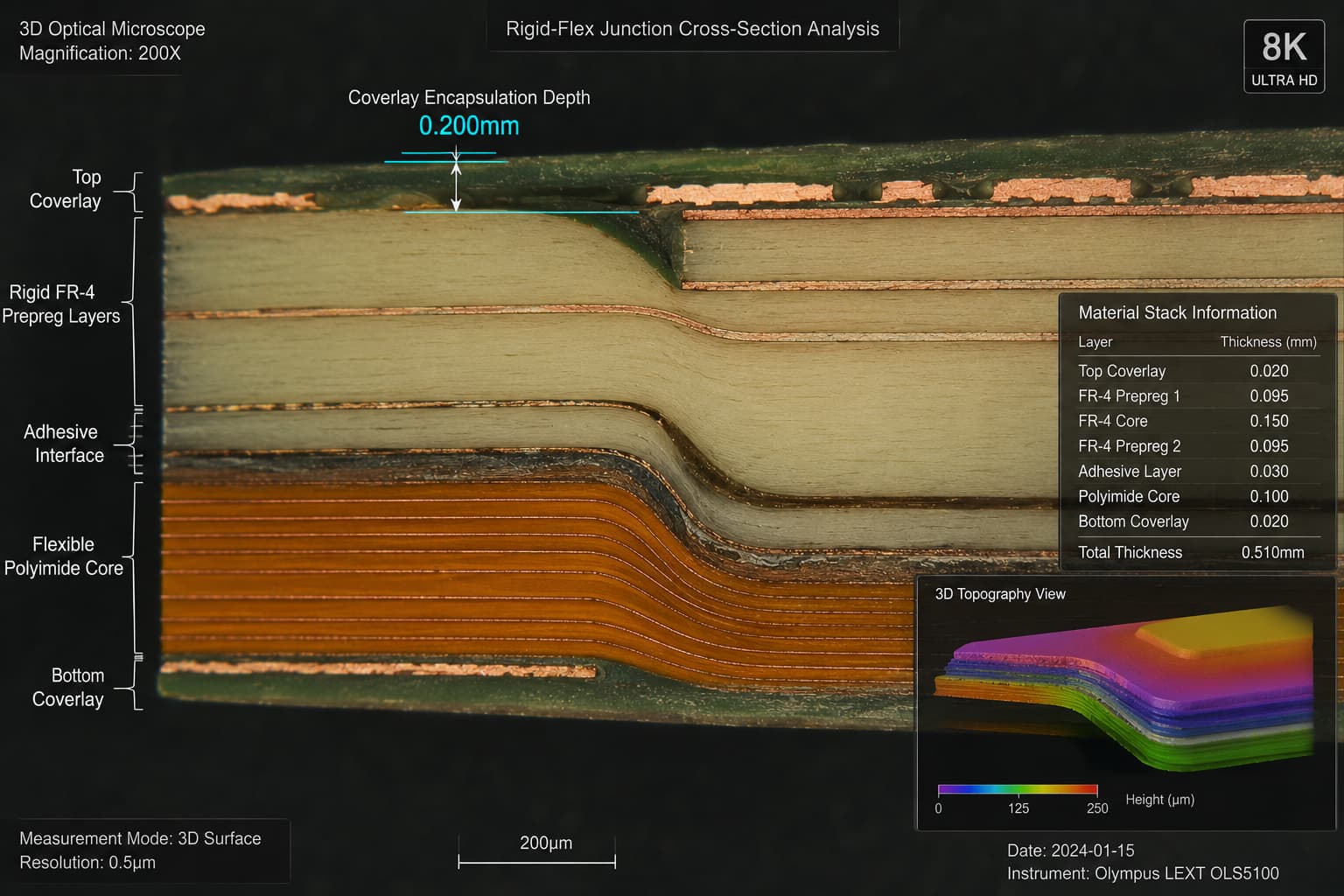
Figure 2: Comprehensive 3D optical microscopic inspection confirming optimized 0.2mm coverlay encapsulation depth under the composite FR-4 prepreg layers.
📋 Technical FAQ: Advanced Rigid-Flex DFM Optimization
Q1: Why is IPC-6013 Class 3 standard necessary when tracking rigid-flex registration parameters?
A1: According to IPC-6013 standards, Class 3 regulates extreme aerospace, medical, and automotive environments. It demands precise misregistration analysis, ensuring that multi-layer flex alignment maintains minimum structural annular rings even after severe high-vibration exposure.
Q2: What is “prepreg bleed” and how does JS Circuit control this phenomenon inside the transition zone?
A2: Prepreg bleed occurs when low-flow or no-flow epoxy resins extrude beyond the rigid board profile during high-pressure lamination. We deploy special computerized press curves and precise glass-cloth prepregs to safely lock resin extension to below 0.15mm beyond the target hinge boundary.
Q3: How do you manage controlled impedance continuity as traces cross from the rigid section into the flexible core?
A3: The dielectric constant (Dk) shifts significantly between FR-4 (~4.2) and Polyimide (~3.4), alongside alterations in reference plane distances. Our DFM engineering team automatically recalculates and modifies trace widths at the transition boundary to maintain a seamless 50Ω single-ended or 100Ω differential impedance path without signal reflections.
Q4: Can standard SMT components be reliably assembled directly onto the flexible region of a rigid-flex board?
A4: Yes, provided proper mechanical support is applied. For component-bearing flex segments, JS Circuit integrates localized rigid FR-4 or stainless steel stiffeners directly behind the SMT landing pads. This prevents the flexible substrate from bowing during solder reflow, eliminating micro-cracking risks in the solder joints during PCBA operations.
Q5: Which surface finish is recommended for rigid-flex designs utilizing highly dynamic, repeating bend applications?
A5: For dynamic links, ENIG (Electroless Nickel Immersion Gold) can sometimes introduce micro-cracking under heavy, repeating fatigue cycles due to the brittle nature of the underlying intermetallic nickel layer. In high-cycling operations, we advise selecting Immersion Silver, OSP, or ENEPIG (Electroless Nickel Electroless Palladium Immersion Gold) to ensure long-term mechanical trace survivability.
Designing highly compact, high-reliability rigid-flex electronics for industrial computing or critical medical devices?
Contact JS Circuit’s design engineering desk today to secure an advanced, zero-obligation DFM verification profile.