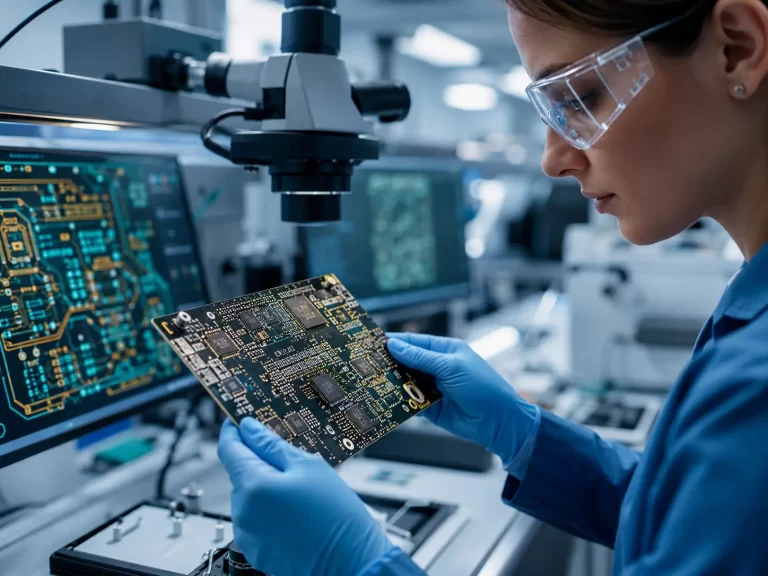
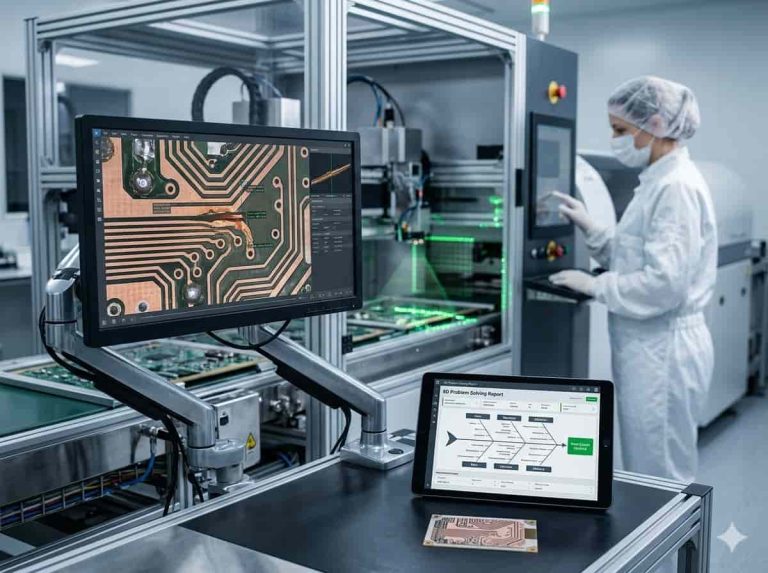
PCB stands for Printed Circuit Board and serves as the foundation of modern electronic devices. This guide explains what PCB means in electronics, how PCB boards function in computers, why failures occur, and whether PCB manufacturing is expensive. Understanding these basics helps engineers and buyers make better sourcing decisions.
What Is PCB Board? Functions, Costs, Failures & Applications Explained
In modern electronics sourcing and product development, PCB terminology, manufacturing costs, and reliability risks often create confusion for engineers and procurement teams. Many projects face delays due to unclear board specifications, unexpected failures, or mismatched manufacturing capabilities.
PCB stands for Printed Circuit Board and serves as the structural and electrical foundation of nearly all electronic devices. It connects and supports components through precisely designed copper pathways, enabling stable signal transmission and power distribution across complex systems.
From consumer electronics to industrial automation equipment, reliable PCB boards are critical for long-term device performance. Understanding the PCB manufacturing process helps buyers evaluate production standards, quality control systems, and supplier reliability.
What Does PCB Mean in Electronics vs Medical Terms?
In electronics, PCB refers to Printed Circuit Board, the backbone of electronic assemblies. However, in medical terminology, PCB may refer to entirely different abbreviations depending on context (such as Polychlorinated Biphenyls in toxicology or Primary Care Board in healthcare administration).
For engineers and buyers, PCB almost always relates to electronic board fabrication and component assembly.
What Is a PCB in a Computer?
Inside a computer, multiple PCB boards coordinate different functions to ensure system stability:
- Motherboard: The primary PCB connecting CPU, memory, and storage.
- Graphics Card PCB: Dedicated circuitry for high-speed image processing.
- Power Supply PCB: Manages complex voltage regulation and distribution.
What Does a PCB Board Do?
The primary role of a PCB is to provide a reliable environment for electronic components to interact.
| Function | Description | Impact on Devices |
|---|---|---|
| Electrical Connection | Links components via copper traces | Ensures stable signal transmission |
| Mechanical Support | Holds components firmly in place | Improves durability and vibration resistance |
| Thermal Management | Dissipates heat through copper planes | Prevents overheating failures |
| Signal Integrity | Controls impedance and interference | Maintains high-speed data accuracy |
Where Are PCB Boards Commonly Used?
PCB applications span across nearly every modern technology industry, each with unique performance standards.
| Industry | PCB Application Focus | Performance Requirement |
|---|---|---|
| Consumer Electronics | Smartphones, laptops, wearables | Miniaturization & high-density routing |
| Automotive Electronics | ECU modules, sensors, infotainment | Heat resistance & vibration durability |
| Industrial Automation | Control systems, robotics, power | High reliability & long service life |
| Medical Devices | Diagnostic & monitoring systems | Precision & strict safety compliance |
Are PCB Boards Expensive to Manufacture?
PCB costs vary depending on design complexity, materials, and production volume:
- Simple single-layer PCBs: Low-cost and widely used in basic consumer goods.
- Multilayer and HDI boards: Cost more due to precision laser drilling and sequential lamination.
- Flexible PCBs (FPC): Typically higher in price because of specialized PI (Polyimide) materials and handling.
Large-scale manufacturing significantly reduces unit costs through production efficiency and panel utilization.
Why Do PCB Boards Fail?
PCB failures usually stem from design flaws, material issues, or environmental stress factors.
| Failure Type | Main Cause | Prevention Method |
|---|---|---|
| Solder Joint Cracking | Thermal cycling stress | Use high-reliability solder materials |
| Delamination | Poor lamination process | Controlled heat & pressure cycles |
| Trace Corrosion | Moisture or contamination | Protective surface finishes (ENIG, OSP) |
| Short Circuits | Design spacing errors | Strict DFM (Design for Manufacturing) |
Expert Commentary & Practical Insights
PCB Design Engineer Response:
“Most PCB failures originate during the design stage rather than fabrication. Proper stack-up planning and thermal simulation prevent common reliability issues before the board hits the factory floor.”
Electronics Manufacturing Consultant Response:
“Buyers often overpay when ordering prototypes in small quantities without optimizing panelization. Partnering with experienced manufacturers reduces redesign cycles and material waste.”
Factory Production Manager Response:
“Stable lamination control and automated optical inspection (AOI) are critical for multilayer PCB consistency. Zero-defect policies start with material traceability.”
PCB vs FPC: Choosing the Right Board Type
Rigid PCBs provide structural strength for most electronics, while Flexible Printed Circuits (FPC) are designed for compact devices requiring bending and space efficiency.
Engineers developing compact electronics often rely on flexible PCB technology and working principles to optimize internal layouts. Understanding the differences between rigid and flexible PCB structures helps designers balance durability, weight, and available space.
Frequently Asked Questions (FAQ)
1. What is the difference between a PCB and a PCBA?
A PCB (Printed Circuit Board) refers to the empty, fabricated board without any components installed. In contrast, a PCBA (Printed Circuit Board Assembly) is the finished product after components like resistors, ICs, and capacitors have been soldered onto the board. Buyers must specify whether they need raw fabrication or full assembly services during the sourcing stage.
2. How much does a standard PCB board cost to make?
The cost of a PCB board is not fixed; it depends on the layer count (2-layer vs. 20-layer), material type (FR-4 vs. Rogers), and surface finish. While simple prototypes can cost as little as $5-$50, mass production unit prices drop significantly to pennies or a few dollars. Specialized features like HDI (High Density Interconnect) or flexible materials will increase the base price.
3. Why are green PCBs the most common color in electronics?
Green is the standard color for the solder mask because it provides the highest contrast for human eyes and automated optical inspection (AOI) systems to detect trace errors. Historically, green resins cured faster and more reliably than other colors, making them the industry standard for high-volume manufacturing efficiency.
4. Can a damaged PCB board be repaired?
Minor damage such as burnt traces or lifted pads can often be repaired using specialized conductive epoxies or jumper wires. However, internal layer failures in multilayer boards or extensive delamination are generally unrepairable. For mission-critical applications like automotive or medical devices, replacing the board is always recommended over repair to ensure safety.
5. How long is the typical lifespan of a PCB board?
A high-quality PCB board can last 10 to 20 years if kept in a controlled, dry environment. However, lifespan is shortened by extreme temperatures, high humidity, and vibration. Selecting the correct surface finish (like ENIG for oxidation resistance) and material Tg (Glass Transition Temperature) is essential for extending the board’s operational life in harsh conditions.
Final Note / Practical Takeaway
PCB boards form the foundation of all electronic systems, and understanding their functions, cost structures, and reliability risks enables smarter engineering and sourcing decisions. From prototype validation to high-volume production, consistent manufacturing quality directly impacts product lifespan and market performance. JS provides end-to-end PCB and FPC manufacturing solutions supported by advanced fabrication equipment, strict quality management systems, and experienced engineering teams. For projects requiring stable performance, customized stack-ups, or complex multilayer designs, working with an experienced manufacturing partner ensures long-term reliability and cost efficiency.
References
- “Printed Circuits Handbook,” Clyde Coombs and Happy Holden, McGraw-Hill Education.
- “IPC-A-600: Acceptability of Printed Boards,” IPC (Association Connecting Electronics Industries).
- “The Printed Circuit Designer’s Guide to… Fundamentals of RF/Microwave PCBs,” American Standard Circuits.
- “Thermal Management in Electronics,” IEEE (Institute of Electrical and Electronics Engineers).
- “Principles of Electronic Packaging,” Seraphim, Lasky, and Li, McGraw-Hill.
- “Electronic Materials and Processes Handbook,” Charles A. Harper, McGraw-Hill Professional.
- “Reliability Analysis of Printed Circuit Boards,” NASA Goddard Space Flight Center.
- “High-Speed Digital Design: A Handbook of Black Magic,” Howard Johnson and Martin Graham, Prentice Hall.
>