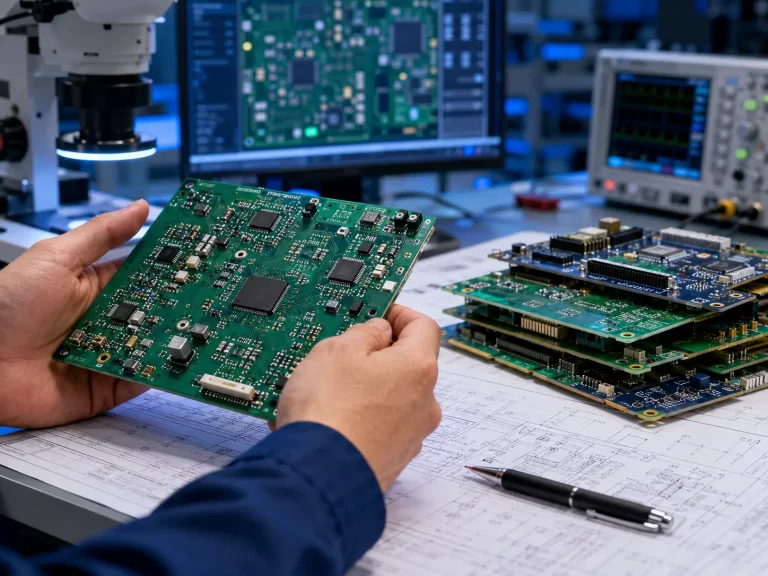
Quick Summary: In the world of electronics, PCB (Printed Circuit Board) and PCBA (Printed Circuit Board Assembly) serve distinct roles. PCB is the bare board used for electrical connection, while PCBA is the fully assembled and functional board with components, ready for use in final products. Understanding the key differences between them is crucial for design, manufacturing, and cost considerations.
Quick Answer: PCB vs PCBA in Simple Terms
If you are comparing PCB vs PCBA, the simplest way to understand it is this:
PCB means the bare printed circuit board.
PCBA means the printed circuit board after electronic components have been assembled onto it.
A PCB is the physical platform that provides electrical pathways and mechanical support for components. A PCBA is the working assembly that can perform real electronic functions inside a device.
PCB is the foundation, while PCBA is the functional electronic product.
This distinction matters more than many buyers realize. In sourcing, engineering, and manufacturing discussions, people often use the two terms interchangeably. That is a mistake. A bare board and an assembled board involve different production stages, different cost structures, different suppliers in some cases, and different quality risks.
For engineers, understanding the difference helps with design planning, prototyping, and production decisions. For buyers and product owners, it helps avoid quotation errors, delays, specification confusion, and unpleasant surprises during mass production.
In plain language, if you only need the board itself, you need a PCB. If you need a board with parts mounted, soldered, tested, and ready for use in a product, you need a PCBA.
That is the short answer. The longer answer is where the real money is saved.
What Is a PCB? Understanding the Basics
A PCB, short for Printed Circuit Board, is the base board used to mechanically support and electrically connect electronic components. It is made by laminating conductive copper layers onto insulating substrate materials, then forming the necessary circuit paths through etching, drilling, and plating processes.
If you have ever opened a charger, control panel, industrial sensor, medical device, or consumer gadget, you have seen a PCB. It is the quiet workhorse behind almost every modern electronic product.
The main job of a PCB is not to “do” the electronic function by itself. Its role is to provide a stable, organized, and reliable structure so components such as resistors, capacitors, integrated circuits, connectors, and sensors can be connected properly.
In other words, the PCB is the road network. The components are the cars, trucks, and buses. Without roads, the traffic goes nowhere. Without components, the roads are just roads.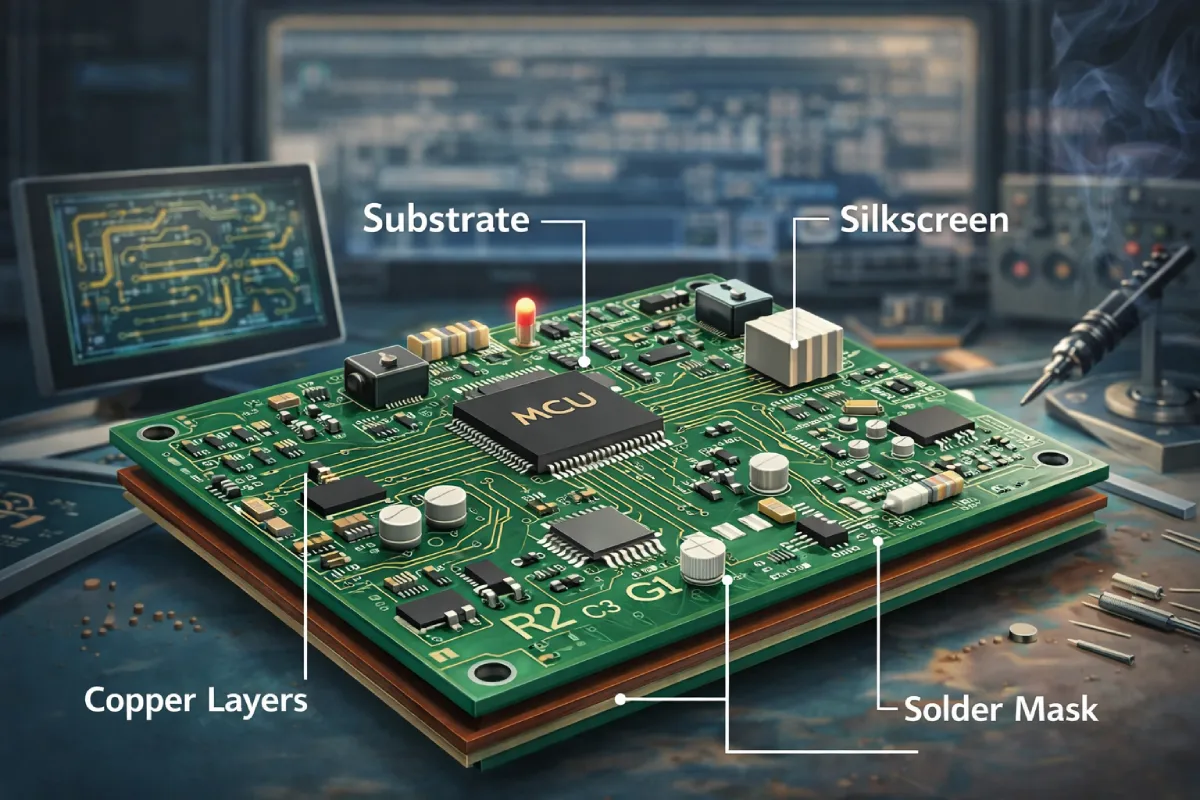
What a PCB Does
A PCB performs several essential tasks in electronic design and manufacturing.
First, it creates conductive paths that allow signals and power to travel between components. These paths are formed from copper traces designed according to the circuit layout.
Second, it provides physical support. Components need a secure mechanical base so the board can survive handling, assembly, vibration, and long-term operation.
Third, it improves consistency. Compared with point-to-point wiring, a PCB offers a cleaner, more repeatable, and more scalable way to build electronic systems.
Fourth, it supports miniaturization. As products become smaller and more complex, well-designed PCBs make it possible to fit a large amount of functionality into compact devices.
Common PCB Types
Not all PCBs are built the same. The board type depends on the application, electrical requirements, thermal needs, space constraints, and product complexity.
Single-layer PCB is the simplest type. It has one conductive copper layer and is commonly used for low-complexity consumer products, simple power supplies, and basic control circuits.
Double-layer PCB has copper on both sides of the substrate. It allows denser routing and is widely used in industrial controls, automotive electronics, and more sophisticated consumer products.
Multilayer PCB includes three or more conductive layers. In practice, many commercial boards use four, six, eight, or more layers. These are common in communication equipment, computers, medical systems, and high-speed electronics where signal integrity and compact design matter.
Flexible PCB can bend and fold, making it ideal for wearable devices, cameras, and space-limited assemblies.
Rigid-flex PCB combines rigid and flexible sections, often used in aerospace, defense, and medical applications where reliability and compact packaging are critical.
Key Materials Used in PCB Manufacturing
The most common substrate material is FR-4, a glass-reinforced epoxy laminate known for its good electrical insulation, mechanical strength, and cost-effectiveness.
Other material options include aluminum-based boards for better thermal management, high-frequency laminates for RF applications, and polyimide materials for flexible boards.
Copper thickness, solder mask color, surface finish, board thickness, and via structure also affect performance and manufacturability. That is why serious PCB manufacturing is never just “send file, print board, done.” Anyone saying that is either oversimplifying or selling fairy tales in a factory hat.
Industry Applications of PCB
PCB manufacturing serves nearly every electronics-driven industry.
Consumer electronics use PCBs in phones, routers, headphones, smart home devices, and gaming equipment.
Automotive electronics rely on them for engine control units, infotainment systems, battery management systems, and safety modules.
Industrial equipment uses PCBs in controllers, sensors, automation devices, and robotics.
Medical devices require high-reliability PCB solutions in diagnostic systems, monitoring equipment, and treatment devices.
Telecommunications, aerospace, renewable energy, and security systems also depend heavily on application-specific PCB design and manufacturing.
That is why the keyword what is PCB matters to both technical readers and commercial buyers. It is not just a textbook definition. It is the starting point for understanding the full electronics manufacturing chain.
What Is PCBA? From Board to Functional Product
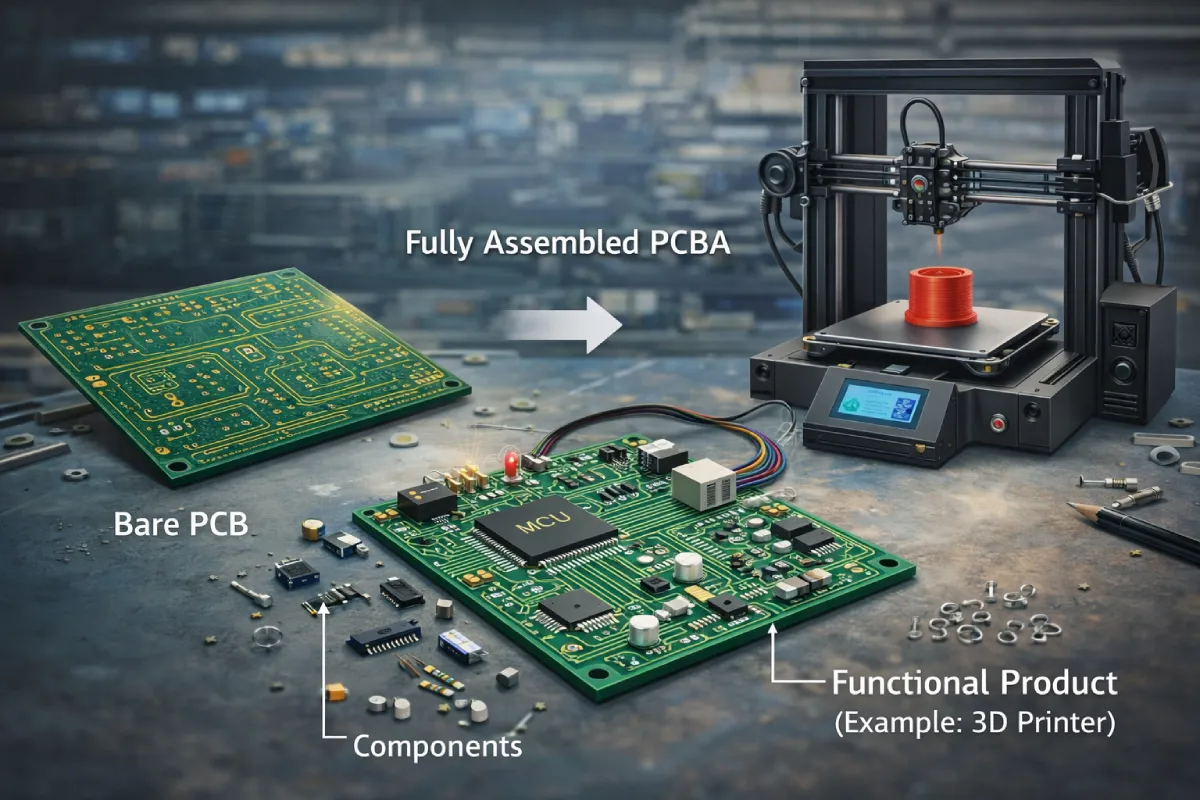
PCBA stands for Printed Circuit Board Assembly. It refers to the process of mounting and soldering electronic components onto a bare PCB so that the board becomes functional.
If a PCB is the skeleton, a PCBA is the body with muscles, nerves, and a heartbeat.
A bare board on its own cannot amplify signals, store data, regulate voltage, sense temperature, or communicate wirelessly. Once components are placed and connected correctly, the board becomes a working electronic assembly capable of performing real tasks.
This is where the meaning of PCB assembly becomes practical. PCBA is not simply “put parts on board.” It is a controlled manufacturing process that includes material preparation, soldering, component placement, inspection, testing, and often rework or validation steps before shipment.
What Happens During PCB Assembly
In a PCBA process, manufacturers first source all required components based on the bill of materials, often called the BOM. These may include chips, resistors, capacitors, connectors, transformers, inductors, sensors, switches, and more.
Then the bare boards are prepared for assembly, often with solder paste applied to the component pads.
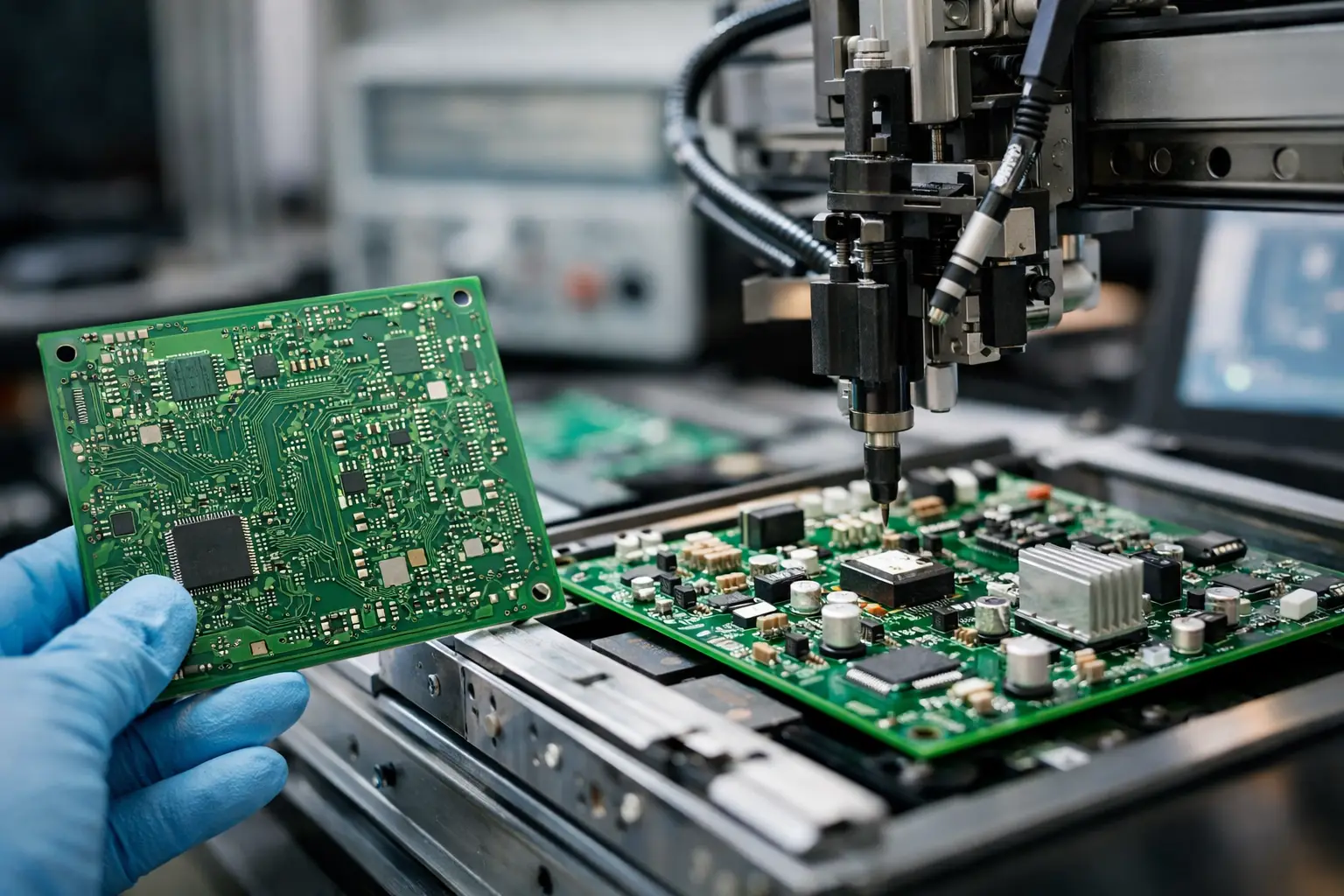
Next comes component placement. Surface-mounted devices are positioned automatically by pick-and-place machines, while through-hole components may be inserted manually or by automation, depending on design and production volume.
The assembly is then soldered, usually through reflow soldering for SMT and wave soldering or selective soldering for some THT applications.
After assembly, the boards are inspected and tested. This is critical. Even if the board looks fine, hidden solder defects, polarity mistakes, tombstoning, insufficient wetting, bridging, or incorrect parts can still cause failure.
SMT and THT in PCBA
Two major assembly technologies dominate modern PCBA production.
SMT, or Surface Mount Technology, places components directly onto the surface of the PCB. It is efficient, fast, and suitable for compact, high-density designs. Most modern electronics use SMT for the majority of components.
THT, or Through-Hole Technology, inserts component leads through drilled holes in the board and solders them on the other side. THT is still used where stronger mechanical attachment is needed, such as power components, connectors, transformers, and products exposed to vibration or harsh environments.
Many electronic assemblies use a mixed process that combines SMT and THT. That is one reason why what is PCBA is not answered fully by saying “it means assembled board.” The real answer includes technology choices, process control, and application requirements.
Testing in PCBA
Testing is one of the biggest differences between a simple board supply model and a professional PCB assembly service.
AOI, or Automated Optical Inspection, is commonly used to detect visible soldering and placement defects.
X-ray inspection is used for hidden joints, especially in BGA and other bottom-terminated packages.
In-circuit testing checks specific electrical nodes and component-level behavior.
Functional testing verifies whether the finished assembly performs its intended operation under defined conditions.
Burn-in or aging tests may be added for products that require higher reliability.
For buyers, this matters enormously. Two suppliers may quote the same board size and same assembly complexity, but one includes robust testing while the other does the manufacturing equivalent of “looks fine from across the room.” Guess which one creates field failures later.
The Full PCBA Workflow
A typical PCBA production flow includes data review, component sourcing, incoming material inspection, solder paste printing, SMT placement, reflow soldering, THT insertion if needed, wave or selective soldering, AOI, electrical testing, cleaning when required, conformal coating for special environments, final inspection, and packaging.
This full-chain workflow is why PCBA carries more risk, more value, and more decision points than PCB alone.
When people search what is PCBA or PCB assembly meaning, they are often trying to understand where the board becomes a product. The answer is here: PCBA is the stage where electronic design turns into something that can actually work in the field.
PCB vs PCBA: Key Differences Explained
Now we get to the core comparison.
Although PCB and PCBA are closely related, they are not the same thing. One is a manufactured board. The other is an assembled and functional electronic unit.
This distinction affects sourcing, budgeting, supplier selection, lead time planning, quality expectations, and project communication.
Here is the most direct PCB vs PCBA difference comparison:
| Aspect | PCB | PCBA |
|---|---|---|
| Definition | Bare board | Assembled board |
| Function | Electrical connection | Full functionality |
| Process | Manufacturing | Assembly |
| Cost | Lower | Higher |
| Application | Base material | End product |
Definition Difference
A PCB is only the board itself. It includes the substrate, copper traces, vias, pads, solder mask, silkscreen, and surface finish, but no mounted components.
A PCBA includes that board plus the complete component assembly and soldering work required to make the board functional.
Function Difference
The PCB serves as the structural and electrical foundation.
The PCBA performs actual functions inside the product, such as control, sensing, communication, power regulation, or signal processing.
This is the simplest way to explain the PCB vs PCBA comparison to a non-technical buyer. One is infrastructure. The other is operation.
Process Difference
PCB production focuses on board fabrication. This includes imaging, etching, drilling, lamination, plating, solder mask coating, silkscreen printing, surface finishing, and final electrical testing of the board itself.
PCBA focuses on assembly and post-fabrication operations. It includes material procurement, solder paste printing, component placement, soldering, inspection, and functional validation.
So when buyers request a quote, the difference is not cosmetic. They are actually asking for different manufacturing scopes.
Cost Difference
A PCB usually costs less than a PCBA because it does not include components, assembly labor, machine programming, testing, or procurement complexity.
A PCBA cost includes the PCB itself plus component cost, assembly process cost, inspection cost, yield risk, and often logistics coordination across multiple material sources.
This is why some projects that appear simple on paper become far more expensive after assembly is included. The board may be cheap. The assembly may not be.
Application Difference
A PCB is typically ordered when the customer still needs to perform in-house assembly, prototype iterations, or testing with their own component strategy.
A PCBA is ordered when the customer wants a ready-to-use assembly, often as part of a turnkey or semi-turnkey manufacturing solution.
For OEM brands, startups, and procurement teams trying to shorten time to market, PCBA usually delivers greater operational value because it reduces the number of production steps they have to coordinate internally.
PCB vs PCBA Process: How They Are Made
Another major area of confusion is the process itself.
Some buyers assume PCB and PCBA are just two names for the same manufacturing stage. They are not. PCB fabrication and PCB assembly are sequential but different processes, with different materials, machinery, engineers, and control points.
Understanding the PCB vs PCBA process helps buyers communicate more accurately with suppliers and reduce avoidable production mistakes.
PCB Manufacturing Process
The manufacturer first prepares the raw laminate material. Copper-clad boards are cut and processed according to the design requirements.
Then the circuit image is transferred to the copper layer. Unwanted copper is removed through etching, leaving the intended traces and pads.
Drilling follows, creating holes for vias and through-hole components. These holes are then plated to establish electrical connectivity between layers when required.
For multilayer PCB manufacturing, lamination is a critical stage. Multiple inner layers are aligned, pressed, and bonded together under heat and pressure.
After that, solder mask is applied to protect the copper and prevent solder bridging during later assembly. Silkscreen markings are added for identification, reference designators, logos, and assembly guidance.
Finally, a surface finish such as HASL, ENIG, OSP, or immersion silver is applied to exposed pads so the board can be soldered reliably during assembly.
Before shipment, the boards usually undergo inspection and electrical testing to confirm open and short conditions.
In short, the PCB manufacturing process turns digital circuit data into a physical board platform.
PCBA Assembly Process
The PCBA assembly process begins after the PCB is ready.
Solder paste is first printed onto the board pads using a stencil. This paste contains metal alloy particles and flux, preparing the board for component attachment.
Next, SMT machines place components onto the pasted pads at high speed and high precision.
The board then passes through a reflow oven, where carefully controlled heating profiles melt the solder paste and permanently connect the components.
If the design includes through-hole parts, these may be inserted afterward and soldered by wave soldering, selective soldering, or manual soldering depending on complexity and volume.
Once assembly is complete, the board moves through inspection and testing. AOI, X-ray, ICT, and functional testing may be used depending on product requirements.
Some assemblies also require cleaning, programming, firmware loading, conformal coating, or custom packaging.
That is the essence of PCB vs PCBA process. PCB fabrication builds the board. PCBA transforms it into a working assembly.
PCB vs PCBA Cost: What Affects Pricing?
This is where technical questions become purchasing questions, and purchasing questions become very expensive if nobody is paying attention.
When buyers compare PCB vs PCBA cost, they often expect a simple number difference. But the real answer depends on multiple variables, and those variables are not equally important.
A PCB quote is mainly affected by board complexity.
A PCBA quote is affected by board complexity plus assembly complexity, component sourcing, process control, testing depth, and production yield.
What Affects PCB Cost
PCB cost is largely shaped by board design and fabrication requirements.
Layer count is a major factor. A single-layer board is far cheaper than an 8-layer or 12-layer board.
Board size also matters because larger boards consume more material and reduce panel utilization efficiency.
Material selection plays a role. Standard FR-4 is usually cost-effective, while high-frequency or high-temperature materials increase price.
Trace width, spacing, via design, hole count, controlled impedance, copper thickness, and special finishes can all affect manufacturing difficulty and cost.
Order quantity matters too. Larger volumes often reduce unit cost because tooling, setup, and process overhead are spread across more units.
What Affects PCBA Cost
PCBA cost includes everything related to PCB plus additional major cost drivers.
The first is component cost. In many assemblies, components make up the largest share of total cost.
The second is assembly complexity. High component count, fine-pitch parts, BGA packages, mixed technology, double-sided placement, and tight tolerances all increase assembly effort.
The third is labor and machine programming. Even automated production requires setup, feeder preparation, process validation, and engineering review.
The fourth is testing. More comprehensive testing adds cost but reduces downstream failure risk.
The fifth is sourcing risk. If certain parts are hard to obtain, subject to long lead times, or require approved alternatives, procurement management becomes more complex.
The sixth is yield management. Difficult assemblies with narrow process windows may have higher defect risk, and that affects the actual manufacturing cost behind the quote.
So yes, PCB assembly cost is higher than PCB cost alone, but not just because “more work is added.” It is higher because the risk, coordination, and value are all much higher.
Applications: When Do You Need PCB vs PCBA?
Understanding when to use PCB vs PCBA is crucial for product development. The decision often hinges on your project’s stage, complexity, and intended use. This section will help you determine which one you need based on specific applications.
When to Choose PCB
PCBs are typically chosen in the early stages of product design and prototyping. If you are working on a project that requires custom circuit design or a minimal electronics system, you may only need a PCB.
PCBs are ideal for scenarios where:
- Prototyping: You want to test a new circuit design before committing to full assembly.
- DIY projects: For hobbyists or small-scale manufacturers who plan to solder components themselves.
- Component testing: When you want to verify individual components and connections before committing to full assembly.
- Initial design iterations: A simple PCB may suffice while refining the design, and PCBA can be completed in later stages.
When to Choose PCBA
PCBA is typically selected for final product development. Once your circuit design is complete and functional, you can proceed with assembling it into a full, operational product.
PCBA is ideal when:
- Finished products: If you are ready to manufacture your product, whether it’s a smartphone, medical device, or home appliance, you need a fully assembled board that is tested and ready to go.
- Mass production: When scaling up to mass production, PCBA is the standard choice to ensure consistent quality, functionality, and ease of integration with other components.
- Ready-to-Use Devices: If your product needs to be plug-and-play for end users, then a PCBA ensures that all the necessary parts are in place and functioning correctly from the get-go.
PCB vs PCBA Applications in Real-World Products
| Application | PCB | PCBA |
|---|---|---|
| DIY Projects | ✔️ | ❌ |
| Prototype Testing | ✔️ | ❌ |
| Consumer Electronics | ❌ | ✔️ |
| Automotive Systems | ❌ | ✔️ |
| Medical Devices | ❌ | ✔️ |
This table shows how the PCB vs PCBA decision plays out in real-world product categories.
When Should You Choose PCB or PCBA Services?
Choosing PCB or PCBA services depends on who you are in the supply chain and what you need from your manufacturer.
If You Are an Engineer
If you’re a product engineer or developer, you are likely looking for a PCB to start building or testing your own components. Engineers typically order PCBs when they are in the design phase and need to test circuits, refine layouts, or ensure that components will fit properly. Once the circuit works on the PCB, you can move to a PCBA when it’s time to produce a finished product.
If You Are a Buyer or Brand Owner
For buyers or brand owners, PCBA is often the end-product you need to source for mass manufacturing. Purchasing a PCBA simplifies your sourcing and production processes because it’s already fully assembled, tested, and ready for final integration into a product. You don’t have to worry about component sourcing, assembly processes, or testing. You get a finished product.
A PCBA service is ideal for customers who want a turnkey solution. You send in your PCB designs, and the manufacturer assembles the board, tests it, and ships the finished product. This saves you time, complexity, and often cost when scaling up production.
Considerations for Choosing Services
When selecting PCB or PCBA services, consider these factors:
- Lead Time: Does your project require a rapid prototype? A PCB service may be quicker.
- Testing Needs: If you need thorough testing for functionality or reliability, PCBA services will handle it.
- Production Volume: For small batches or quick iterations, PCBs may be more cost-effective. For large-scale production, PCBA services help streamline processes.
- Customization: If your design is still evolving, you may prefer ordering just a PCB to avoid paying for unnecessary assembly.
PCB vs PCBA: Common Mistakes Buyers Make
When sourcing PCBs or PCBA, buyers can make several critical mistakes that lead to delays, cost overruns, or poor-quality products.
1. Confusing PCB with the Finished Product
One of the most common mistakes is thinking that the bare PCB is the finished product. A PCB is not functional until components are assembled onto it. Many buyers mistakenly order PCBs expecting a fully working product.
2. Underestimating Assembly Complexity
Another mistake is underestimating the complexity of assembly. Some buyers assume that assembling components on a PCB is straightforward, but it requires precise machinery, skilled technicians, and rigorous testing. The complexity increases with the type of components used, such as fine-pitch ICs or BGAs.
3. Ignoring Testing
A common mistake in the PCB and PCBA process is neglecting testing, particularly for PCBA. While PCBs can be tested for electrical continuity, functional testing for a complete PCBA ensures that the board performs as expected in real-world conditions.
4. Focusing Only on the Cost of the PCB
Buyers often focus too much on the PCB price without factoring in the assembly costs. While the PCB itself may be cheap, the assembly process adds substantial cost. A comprehensive PCBA service often includes labor, machine time, component sourcing, testing, and potential rework.
5. Not Considering Long-Term Availability of Components
Some buyers neglect to check if the components required for the assembly are readily available or if there are long lead times. This can delay production and increase costs, especially if substitutes or reengineering are necessary.
FAQ
1. What is the main difference between PCB and PCBA?
Answer: The main difference between PCB and PCBA is that PCB refers to the bare board without components, while PCBA is the fully assembled board with components mounted and soldered on it. PCBs are used in prototyping and as the foundation for electronic systems, while PCBA is the functional final product.
2. Is PCBA the same as a finished product?
Answer: Yes, PCBA (Printed Circuit Board Assembly) is considered a finished product, ready to be integrated into a larger device. It contains all the necessary components mounted on the PCB, allowing it to perform specific functions such as signal processing or power management.
3. Can I order PCB without assembly?
Answer: Yes, you can order a PCB without assembly if you only need the bare board for prototyping, testing, or DIY purposes. However, for mass production or when the board needs to be functional, assembly (PCBA) is required.
4. How long does PCB assembly take?
Answer: The time required for PCB assembly can vary depending on the complexity and size of the order. Typically, it takes anywhere from a few days to several weeks, depending on factors like the number of components, the testing process, and whether any custom configurations are involved.
5. Which is more expensive, PCB or PCBA?
Answer: PCBA is generally more expensive than PCB. This is because the cost of PCBA includes not only the PCB itself but also the components, labor for assembly, testing, and other processes such as soldering and inspection.
Conclusion: PCB vs PCBA – Which One Do You Really Need?
In conclusion, deciding between PCB and PCBA is not just a technical distinction; it’s a strategic decision that affects your design process, costs, and lead time.
- PCBs are essential for prototyping, testing, and the early stages of development.
- PCBA is the final solution for mass production, delivering a fully functional product.
Understanding the difference, choosing the right service, and avoiding common mistakes will ensure that you get the right solution for your project.
If you’re working on a new product, ensure you communicate clearly with your supplier to avoid confusion. If you’re scaling up, consider working with a professional PCB assembly manufacturer to streamline your production process and meet your quality goals.
References
- “Printed Circuit Boards: Design and Technology”, by C. W. Tao, McGraw-Hill Education, 2012.
- “The PCB Design Guide to Optimizing Your Product’s Performance”, by D. Johnson, PCB Design Magazine, 2019.
- “Introduction to PCB Assembly”, by J. Leach, IPC International, Inc., 2015.
- “Surface-Mount Technology (SMT) in PCB Assembly”, by S. R. Singh, IEEE Transactions on Electronics Packaging Manufacturing, 2018.
- “PCB vs. PCBA: Understanding the Differences in Electronics Manufacturing”, by A. R. Ford, Electronics Weekly, 2020.
- “The Role of Testing in PCB Assembly”, by T. J. Lanza, Jabil Inc., 2016.
- “A Comprehensive Guide to Printed Circuit Board Assembly”, by G. S. Brown, Advanced Circuits, 2017.
- “Cost Factors in PCB Assembly”, by M. S. Clark, PCBWay, 2021.
Semantic Insights: Understanding PCB and PCBA in Depth
Why Choose PCB or PCBA? Understanding when to select PCB or PCBA services plays a critical role in streamlining production and ensuring quality. While PCBs are ideal for prototyping and testing, PCBA is necessary for creating fully functional, market-ready products. Engineers, procurement teams, and product developers must assess their needs carefully to make the right choice for their specific project.
What Makes PCBA a Key Step in Product Development? PCBA is the turning point in product design, where a bare PCB transforms into a fully functional, tested, and ready-to-use board. The assembly process adds crucial elements such as resistors, capacitors, and connectors that enable the product to perform its intended functions. With various testing procedures like AOI and functional testing, PCBA ensures reliability and durability in real-world applications.
How Does Cost Influence Your Decision? The cost of PCB and PCBA is another important factor that directly impacts your sourcing and production strategies. PCB manufacturing generally costs less due to its simpler nature. In contrast, PCBA involves additional expenses related to component procurement, labor for assembly, testing, and quality assurance, making it more expensive than PCB alone. However, the added cost of PCBA is justified by the readiness of the product for integration and final use.
What Are the Industry Applications of PCB vs PCBA? The use cases for PCBs and PCBA are vast and span across industries. PCBs are used in everything from consumer electronics to industrial machinery, serving as the backbone of the electronic systems. However, when it comes to end products that require functionality, such as smartphones, medical devices, or automotive systems, PCBA is essential. Understanding the distinction between the two helps manufacturers select the right solution for their needs.
Considerations for Making the Right Choice When choosing between PCB and PCBA, several factors must be considered. These include product complexity, lead time, testing requirements, and scalability. For prototyping or low-volume runs, PCBs are ideal. For mass production, PCBA is often the most efficient solution. Manufacturers should also consider whether they need assembly services and whether they require a full turnkey solution.