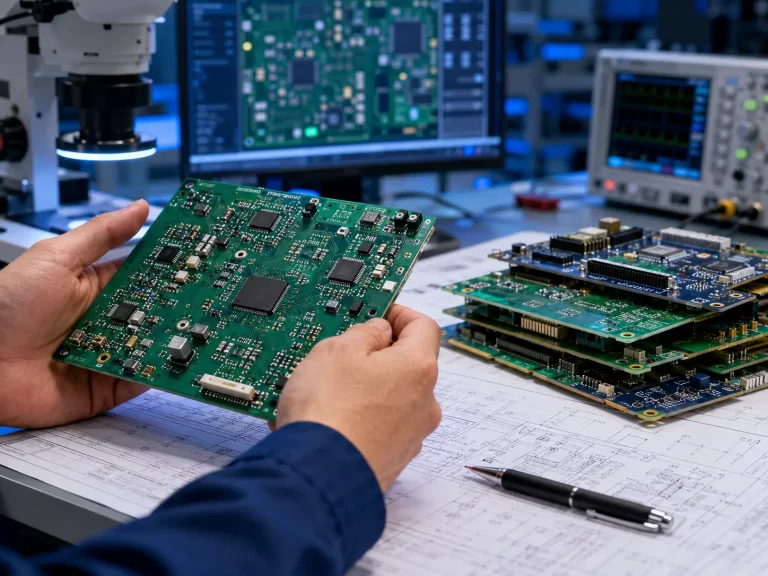
What is Quick Turn PCB Assembly?
Quick turn PCB assembly is a specialized service that focuses on fast turnaround times for PCB production and assembly. It refers to the ability to rapidly manufacture and assemble printed circuit boards (PCBs) with minimal lead time. Quick turn PCB assembly is especially beneficial for industries that require rapid prototyping, low-volume production, or time-sensitive projects.
In simple terms, quick turn PCB assembly accelerates the time from design to finished product, making it possible for engineers, designers, and companies to test new products, improve designs, and bring products to market more quickly than traditional PCB assembly methods.
Quick turn services are essential in the world of electronics, where speed, quality, and innovation are key to staying competitive. This process involves both the manufacturing of the PCB and the assembly of electronic components onto the board, ensuring the product is ready for use as quickly as possible.
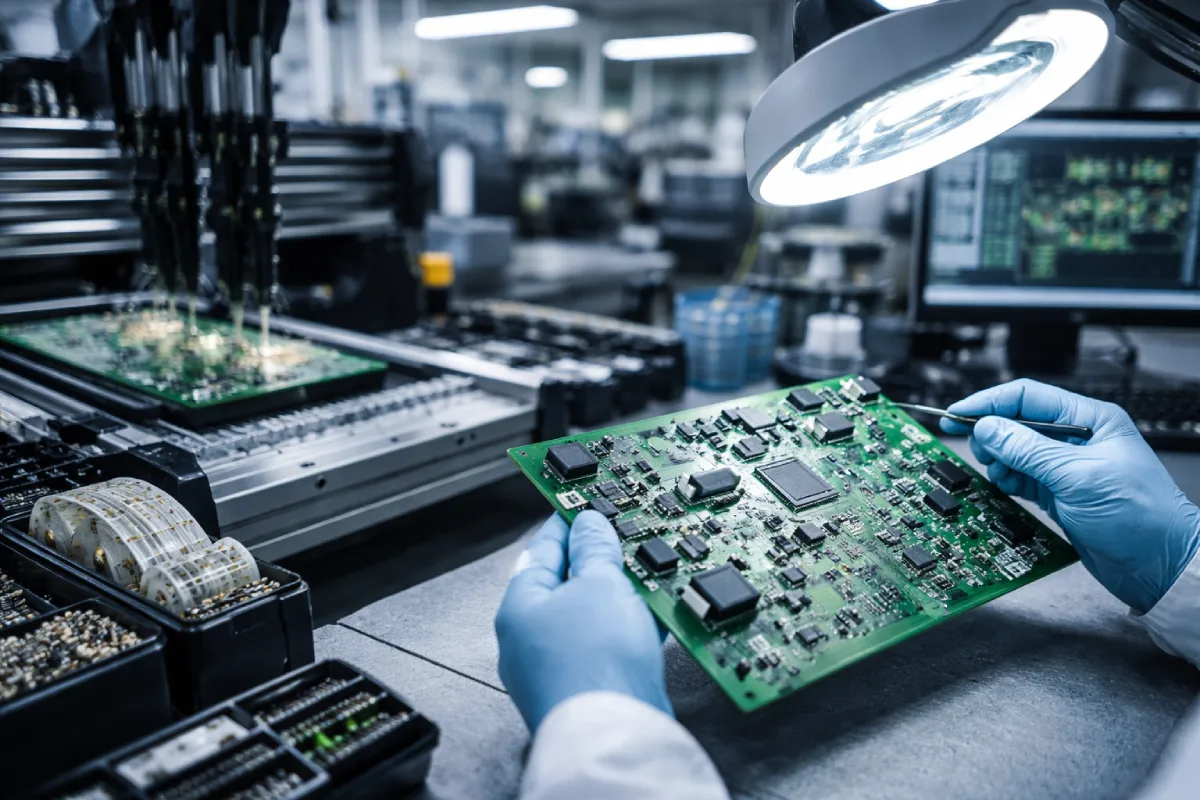
Why is it important?
The demand for quick turn PCB assembly services has grown significantly, as companies need to accelerate product development cycles. This speed is especially critical in fast-moving sectors like consumer electronics, telecommunications, automotive, medical devices, and IoT (Internet of Things).
Quick turn assembly allows businesses to rapidly validate designs, build prototypes, and test functionality. It also helps reduce time-to-market for products, which is vital in industries where first-mover advantage can make a huge difference.
Additionally, quick turn PCB assembly is a cost-effective way to test new designs without committing to large production volumes. It enables companies to evaluate the performance of a product early on and make necessary adjustments before committing to mass production.
Why Choose Quick Turn PCB Assembly?
There are several key reasons why you might choose quick turn PCB assembly for your project. Below are some of the most significant advantages:
Faster Product Development
In the world of electronics, time-to-market is one of the most critical factors in the success of a product. Quick turn PCB assembly services significantly shorten the product development timeline. With a faster turnaround, engineers and designers can iterate on their designs more quickly, making necessary changes to the PCB before moving on to mass production.
This quick feedback loop is essential for reducing the time between concept, design, prototype, and production, enabling businesses to release their products sooner and gain a competitive edge in the market.
Cost Efficiency for Prototyping
When developing a new product, the cost of prototyping can quickly add up. Quick turn PCB assembly services are typically more cost-effective than traditional methods because they are designed for smaller batch sizes. These services allow businesses to order low quantities of PCBs and receive them within a short period, reducing the overhead costs typically associated with large production runs.
Furthermore, quick turn services help minimize waste by ensuring that only the necessary number of PCBs are produced and assembled, lowering material costs.
Flexibility in Production
Quick turn PCB assembly services provide flexibility for different types of production needs. Whether you need a small run for a prototype or a medium-volume production run, quick turn services can adapt to your requirements. This flexibility is particularly valuable for startups, small businesses, or companies working on limited-run or specialized products.
For businesses that need to make changes or adjustments to their designs during development, quick turn PCB assembly allows for rapid testing and modification, ensuring that the final product is exactly what the business needs.
Quick Time-to-Market
In industries like consumer electronics, medical devices, and automotive, the ability to get a product to market quickly is crucial. Quick turn PCB assembly ensures that your product is not delayed during the manufacturing process. With rapid prototyping, assembly, and testing, your product can be launched much sooner, giving you a competitive advantage in a crowded market.
The Quick Turn PCB Assembly Process
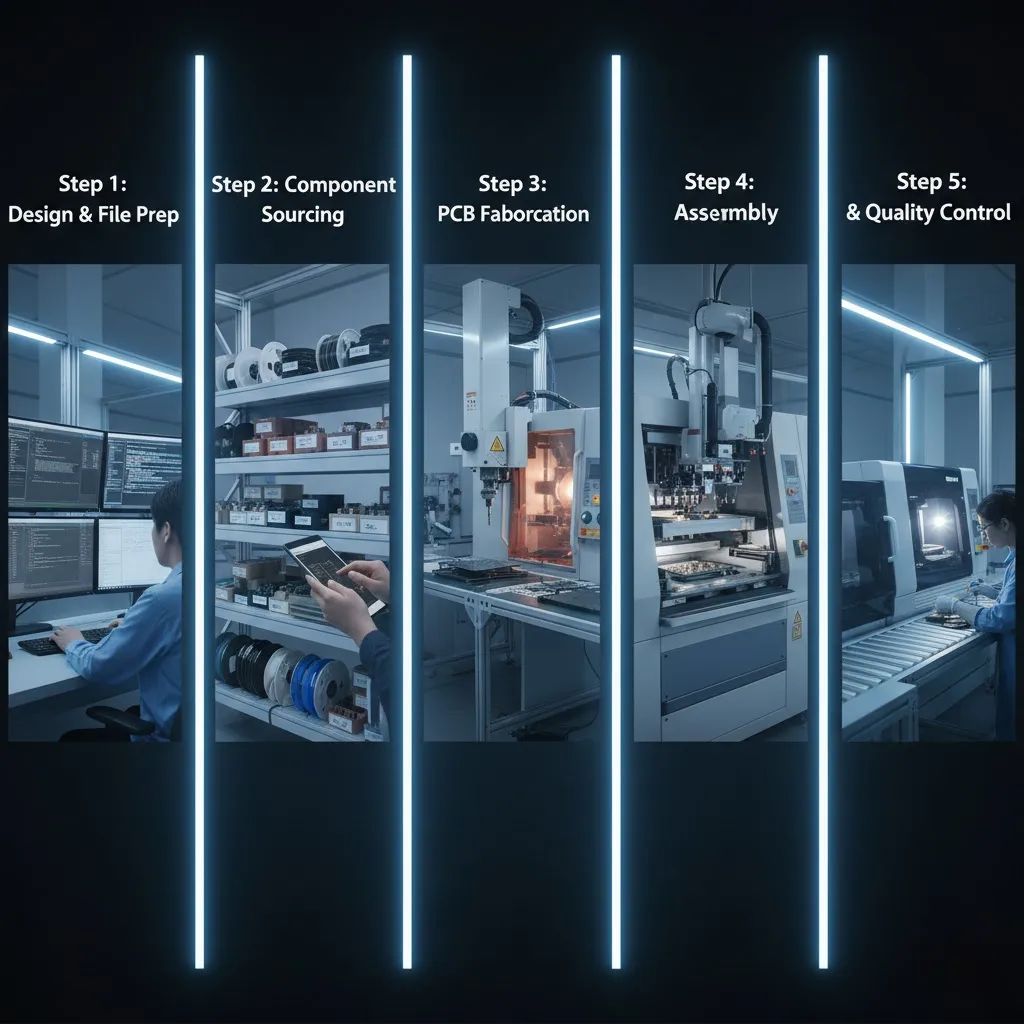
Understanding the quick turn PCB assembly process is essential for anyone considering this service. The process involves several key stages, from design to final product testing. Below is a step-by-step breakdown of the typical stages in a quick turn PCB assembly process:
Step 1: Design and File Preparation
The first stage in the quick turn PCB assembly process is preparing the design files. Engineers create PCB designs using CAD (Computer-Aided Design) software. These files include the layout of the PCB, the placement of components, and the necessary routing for electrical connections.
Once the design is complete, the files are exported in formats such as Gerber files, which contain all the necessary data for PCB manufacturing. These files are then reviewed to ensure accuracy and to identify any potential issues before production begins.
Additionally, a bill of materials (BOM) is prepared, listing all the components required for assembly. The BOM is essential for sourcing the right parts and ensuring they are available when needed.
Step 2: Component Sourcing
After the design files are prepared, the next step is sourcing the components required for the assembly. In quick turn PCB assembly, component sourcing plays a crucial role in meeting tight deadlines. The assembly house will often have established relationships with component suppliers to ensure that the necessary parts are available quickly.
For high-demand components, it is crucial to plan for potential supply chain delays. Quick turn PCB services typically prioritize sourcing components that are readily available to prevent delays in production.
Step 3: PCB Fabrication
Once the design files are finalized and components are sourced, the next step is fabricating the bare PCB. This process involves creating the substrate material (usually made of fiberglass or other durable materials) and applying copper traces that form the electrical pathways.
In quick turn services, PCB fabrication is accelerated by using automated processes that minimize human intervention and reduce production time. The manufacturing process also involves drilling holes for component leads, plating the copper traces, and applying solder mask to prevent accidental soldering on unwanted areas of the board.
Step 4: Assembly
The assembly stage involves placing electronic components on the PCB. In quick turn PCB assembly, this is typically done using automated pick-and-place machines, which can place components accurately and rapidly onto the PCB.
For surface-mount components (SMT), the PCB is printed with solder paste, and the components are placed using automated machines. The board then moves through a reflow oven, where the solder paste melts and forms a solid electrical connection between the components and the PCB.
Through-hole components are also inserted and soldered onto the board. In some cases, selective soldering or wave soldering is used for through-hole parts.
Step 5: Testing and Quality Control
Once the assembly is complete, the PCB undergoes testing to ensure it functions as expected. In a quick turn PCB assembly process, this testing phase is vital to identify and correct any issues before shipping the product.
Automated Optical Inspection (AOI) is often used to check for soldering defects, component misplacement, or incorrect polarity. In-circuit testing (ICT) is also used to check for continuity and signal integrity across the board.
Functional testing verifies that the PCB operates correctly in its intended environment. If necessary, additional testing, such as burn-in testing, can be conducted to ensure the PCB performs reliably over time.
Quick Turn PCB Assembly: Key Data Insights
| Process Stage | Time (Standard) | Quick Turn Time | Key Components Involved |
|---|---|---|---|
| Design & File Preparation | 1–3 days | 1 day | Design files (Gerber, BOM) |
| Component Sourcing | 5–7 days | 1–2 days | Component suppliers, BOM |
| PCB Fabrication | 7–10 days | 3–5 days | Copper layers, substrate material |
| Assembly | 5–7 days | 2–3 days | Automated placement, soldering |
| Testing & QC | 2–5 days | 1–2 days | AOI, functional testing |
Cost Considerations for Quick Turn PCB Assembly
When considering quick turn PCB assembly services, cost is a significant factor. The price of quick turn PCB assembly typically depends on several factors:
- Complexity of Design: The more complex the PCB design, the higher the cost of both fabrication and assembly.
- Material Selection: The choice of materials for the PCB and components can affect the overall cost. High-performance materials or specialty components are often more expensive.
- Volume of Production: Smaller production runs are usually more expensive per unit than larger production runs, though quick turn services often offer reasonable pricing for low-volume production.
- Lead Time: Faster lead times may come with a premium charge, as the assembly process needs to be expedited.
Choosing the Right Quick Turn PCB Assembly Provider
When choosing a quick turn PCB assembly provider, there are several key factors to consider to ensure that you’re getting the best service for your needs. Since the speed of production is crucial in quick turn services, finding a reliable and efficient provider is essential.
What to Look for in a Provider
- Experience and Reputation
A reliable provider should have a solid track record in delivering high-quality PCBs on time. Check the company’s experience with both low-volume and high-velocity projects. An experienced provider will be able to navigate challenges, minimize delays, and guarantee consistent quality. - Lead Time Guarantees
Since quick turn PCB assembly is all about speed, it’s vital to choose a provider that can meet your required lead time. Some companies specialize in ultra-fast turnaround, promising assembly in 24 hours or less. Be sure to clarify lead times and ensure that the provider can meet your project deadlines. - Testing and Quality Control
Quality assurance is an essential part of PCB assembly. Choose a provider that employs rigorous testing methods to ensure that the assembled PCB functions properly. Automated Optical Inspection (AOI), in-circuit testing (ICT), and functional testing should be standard offerings. - Component Sourcing
A provider with an extensive network of suppliers and access to a wide variety of components will be able to handle last-minute part shortages or substitutions. Be sure the provider has access to the components you need, and understand their sourcing process and the availability of components. - Customer Service and Communication
A responsive, customer-focused provider is essential, especially when you’re under time constraints. Choose a company that offers clear communication and an efficient support system. The ability to quickly resolve any issues that arise during the assembly process is critical for ensuring timely delivery. - Certifications and Standards
Look for providers who follow internationally recognized quality standards. Certifications such as ISO 9001 or IPC standards (IPC-A-610 for electronic assembly quality) are a good indication that the provider maintains high manufacturing standards.
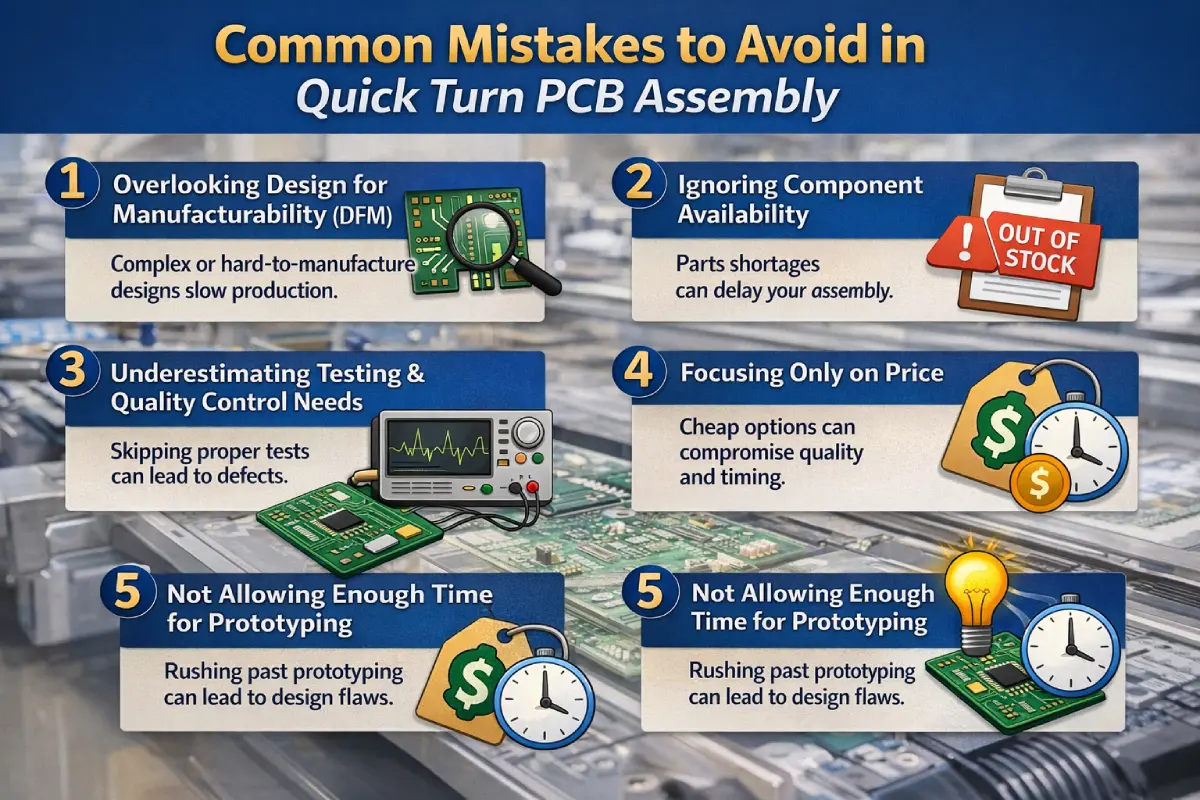
Common Mistakes to Avoid in Quick Turn PCB Assembly
When using quick turn PCB assembly services, several common mistakes can delay the process, affect quality, or increase costs. Avoiding these pitfalls will help you ensure a smooth and successful project.
1. Overlooking Design for Manufacturability (DFM)
Designing a PCB that is easy to manufacture is essential, especially when time is of the essence. Avoid overly complex designs that make assembly difficult. Features such as small trace widths, complex vias, or irregular component placements can slow down the production process and make it harder to meet quick turn deadlines. Always design for manufacturability to speed up production.
2. Ignoring Component Availability
One of the most critical factors in quick turn PCB assembly is component availability. If the components required for assembly are not readily available or are in high demand, it could delay the entire production process. Make sure to choose components with readily available stock, or discuss alternatives with your provider if parts are difficult to source.
3. Underestimating Testing and Quality Control Needs
Some companies may rush through the testing phase in the interest of saving time. However, this can lead to serious reliability issues down the line. Always factor in time for proper testing to ensure that your PCBs are fully functional. Ignoring this can result in defective products that cause delays or even failure in the final application.
4. Focusing Only on Price
While cost is always a consideration, focusing solely on price can lead to poor quality or missed deadlines. In quick turn PCB assembly, the cheapest option may not always be the best. Prioritize quality, reliability, and speed, and consider the long-term benefits of choosing a higher-quality provider that can meet your deadlines without compromising on performance.
5. Not Allowing Enough Time for Prototyping
Although quick turn services aim to provide rapid assembly, it’s important to allow time for prototyping and iterative testing. Skipping this step or rushing through it could result in design flaws or integration issues that are difficult to fix once production is complete. Allow enough time for revisions and improvements before moving to full-scale production.
When to Use Quick Turn PCB Assembly
Quick turn PCB assembly is ideal for situations where speed is critical and when time-to-market must be minimized. Here are some of the scenarios where quick turn PCB assembly can provide significant value:
Prototyping
If you are developing a new product and need to test a design or perform functional testing, quick turn PCB assembly is perfect for prototypes. Prototyping is crucial to identify any flaws in the design or assembly process before moving to mass production. Quick turn services allow you to iterate quickly, test various components, and refine the design without waiting long periods for traditional assembly.
Small-Volume Production Runs
Quick turn PCB assembly is also ideal for low-volume production runs. Whether you’re creating a limited batch of products for initial market testing or a small production run for a specific application, quick turn services provide a cost-effective and time-efficient solution.
Time-Sensitive Projects
In industries such as medical devices, consumer electronics, or automotive systems, quick turn PCB assembly is essential for meeting strict deadlines. If your project is dependent on getting products into the market quickly, quick turn services can ensure that your product is ready on time, allowing you to beat competitors and capitalize on opportunities.
Conclusion: Why Quick Turn PCB Assembly is Essential for Modern Electronics Development
In conclusion, quick turn PCB assembly is a vital service for companies looking to accelerate their product development timelines, reduce costs, and enhance their ability to innovate. Whether you are prototyping a new product, conducting low-volume production, or working on time-sensitive projects, quick turn services offer a reliable and efficient solution for bringing electronic products to market faster.
By choosing the right quick turn PCB assembly provider, avoiding common mistakes, and understanding the process and costs involved, you can ensure that your project runs smoothly and meets its deadlines.
Quick turn PCB assembly is more than just a fast service; it’s a strategic advantage that helps businesses stay competitive in an ever-evolving market. Embrace the speed and flexibility that quick turn assembly offers, and ensure your next project is a success.
FAQs
1. How fast is quick turn PCB assembly for prototypes and urgent projects?
Quick turn PCB assembly is designed for projects that cannot afford long manufacturing cycles. In many cases, a fast-turn service can complete prototype assembly in as little as 24 to 72 hours, although the actual timeline depends on board complexity, layer count, component availability, testing scope, and whether the order includes full turnkey sourcing. In practice, the fastest projects are usually simple, low-volume boards with standard components that are already in stock, while complex assemblies with fine-pitch parts, BGAs, or special materials take longer. Industry guidance around PCB documentation, assembly preparation, and DFM also shows that speed depends heavily on how complete and manufacturable the design package is before production starts.
2. Is quick turn PCB assembly only for prototypes, or can it also support small-batch production?
Quick turn PCB assembly is most commonly associated with prototyping, but it is not limited to prototypes. It is also widely used for engineering validation, pilot runs, low-volume commercial production, urgent replacement boards, and pre-launch market testing. Many manufacturers use quick turn services to move from concept to validation faster, then transition the same design into larger-scale production once performance, sourcing, and manufacturability have been confirmed. The broader manufacturing guidance from PCB industry resources also supports this workflow, especially when teams are trying to reduce redesign cycles before volume manufacturing.
3. What files and information do manufacturers need before starting quick turn PCB assembly?
To start quick turn PCB assembly efficiently, manufacturers usually need a complete release package rather than just a PCB layout file. At minimum, this often includes Gerber or ODB++ files, drill data, a bill of materials, centroid or pick-and-place files, assembly drawings, stack-up details when relevant, and clear fabrication and inspection notes. If the documentation is incomplete, the assembler must pause for clarification, and that defeats the whole point of a fast-turn service. Assembly documentation guidance from Altium and Siemens also emphasizes that fabrication, assembly, and inspection depend on clear outputs and instructions, not guesswork.
4. What factors increase the cost of quick turn PCB assembly the most?
The biggest cost drivers in quick turn PCB assembly are usually urgency, board complexity, and component sourcing. A simple two-layer board with common parts is far cheaper to assemble quickly than a dense multilayer board using fine-pitch packages, double-sided SMT, special finishes, or hard-to-source components. Testing depth also matters: AOI, X-ray inspection, in-circuit testing, and functional testing all add value, but they also add time and cost. Design-for-manufacturing and design-for-assembly guidance consistently shows that better layout decisions can reduce assembly complexity, improve yield, and help control total production cost.
5. How can buyers reduce delays and improve success in quick turn PCB assembly?
The best way to reduce delays is to treat quick turn PCB assembly as a preparation challenge, not just a speed challenge. Buyers should finalize manufacturable designs, avoid unnecessary component risk, confirm substitute parts early, provide complete assembly files, and align testing requirements before the order enters production. It also helps to choose components with stable availability and to work with an assembly partner that can communicate quickly when issues appear. Across PCB manufacturing and assembly resources, the consistent lesson is simple: right-first-time documentation and DFM/DFA discipline are what make fast turnaround actually possible. Otherwise, “quick turn” turns into “quick headache,” which is a very expensive genre of optimism.
References
- “PCB Design Guide & Basics,” Altium, Altium, official resource center.
- “Design for Manufacturing Guidebook,” Altium, Altium Resources, guidebook.
- “The Startup’s Guide to PCB Manufacturing,” Zachariah Peterson, Altium Resources, technical article.
- “How to Optimize PCB Design for the SMT Assembly Process Flow,” Don Kost, Siemens Digital Industries Software, blog.
- “Design for Manufacturing (DFM),” Altium, Altium Resources, engineering resource.
- “Simple Documentation for Hand PCB Assembly,” Zachariah Peterson, Altium Resources, technical article.
- “ABCs of PCBs – M for Manufacturing,” Shivani Joshi, Siemens Digital Industries Software, blog series.
- “DFA Guidelines for an Efficient PCB Design,” Altium, Altium Resources, engineering article.
Quick Turn PCB Assembly: Strategic Insight for Buyers, Engineers, and Fast-Moving Projects
Quick turn PCB assembly is no longer just a convenience service for rushed prototypes. In many sectors, it has become a practical manufacturing strategy for shortening product validation cycles, reducing development bottlenecks, and improving launch readiness. When teams need fast PCB assembly for engineering samples, small-batch verification, or urgent replacement boards, the real value is not only speed. The bigger advantage is the ability to move from design files to functional hardware with fewer delays across sourcing, fabrication, assembly, and testing.
From a technical perspective, the best quick turn PCB assembly projects are usually the ones that are prepared well before production starts. Clear Gerber files, accurate BOM data, complete pick-and-place files, realistic component selections, and manufacturable layouts all have a direct impact on turnaround time. In other words, fast delivery is rarely created by “factory magic.” It is usually the result of good engineering discipline, predictable material planning, and a supplier that can manage rapid coordination without losing control of quality.
How does quick turn PCB assembly actually reduce development time?
It reduces development time by compressing multiple manufacturing stages into a more responsive workflow. Instead of treating PCB fabrication, component sourcing, SMT placement, through-hole assembly, inspection, and testing as disconnected tasks, a strong quick turn process aligns them under one schedule. This matters most during prototyping, design validation, EVT/DVT phases, and customer sample preparation, where every extra day can delay approvals, firmware work, enclosure fitting, or pilot production.
Why do buyers choose quick turn PCB assembly instead of standard production?
Buyers usually choose it when timing is more valuable than pure unit-price optimization. That includes startups preparing investor demos, OEM teams validating revised hardware, industrial buyers replacing boards in maintenance scenarios, and medical or control-system projects that need engineering confirmation before full release. In these cases, rapid PCB prototyping and turnkey PCB assembly are not just purchasing options. They are risk-reduction tools that help teams identify design issues earlier, avoid expensive rework later, and maintain commercial momentum.
What makes one quick turn PCB assembly project easy and another one painfully slow?
The difference often comes down to documentation quality, component strategy, and design complexity. Projects move faster when they use standard stack-ups, common surface-mount parts, realistic tolerances, and test-ready documentation. They slow down when they rely on hard-to-source components, mixed revisions, unclear assembly notes, or layouts that were never reviewed for manufacturability. A quick turn service can accelerate production, but it cannot completely rescue a design package that arrives confused, incomplete, or overly optimistic. Electronics manufacturing is fast, but it is not a wizard.
What options do buyers usually have when ordering quick turn PCB assembly?
Most buyers can choose between consigned assembly, partial turnkey assembly, and full turnkey PCB assembly service. Consigned assembly works when the customer supplies parts directly. Partial turnkey is useful when some components are customer-controlled and others are sourced by the manufacturer. Full turnkey is often the most efficient choice for overseas buyers or product teams that want one supplier to handle PCB fabrication, component sourcing, assembly, and testing under a single workflow. The right option depends on schedule pressure, sourcing control, compliance requirements, and whether the team wants to minimize vendor coordination.
What should engineers and sourcing teams consider before placing an urgent order?
They should evaluate five things carefully: documentation completeness, component availability, manufacturability, test expectations, and acceptable trade-offs between speed and cost. If the BOM contains obsolete parts, the assembly house will lose time sourcing alternates. If the design includes complex packages without proper land pattern control, yield can suffer. If functional testing is required but not defined in advance, shipment may be delayed while expectations are clarified. The fastest projects usually happen when technical, purchasing, and production decisions are aligned before the order is released.
How does quality fit into a fast-turn model?
High-quality quick turn PCB assembly is not simply about building faster. It is about maintaining process control under shorter timelines. Reliable suppliers still need solder paste inspection, accurate machine setup, AOI verification, reflow profile management, and appropriate electrical or functional testing. Speed without inspection creates hidden defects, and hidden defects are where “cheap” projects go to become expensive warranty claims. For most serious applications, the ideal supplier is not the one that promises the fastest number on paper, but the one that can deliver fast while still protecting yield and functional reliability.
Why is quick turn PCB assembly becoming more important in modern electronics manufacturing?
Because development cycles are shrinking while board complexity is rising. Products now move through more revision loops, more software-hardware integration stages, and more market pressure than before. Teams need hardware sooner, not eventually. That is why quick turn PCB assembly is increasingly used not just by R&D labs, but also by OEMs, automation suppliers, IoT brands, industrial control companies, and design houses that need to validate hardware decisions faster. In this environment, rapid execution is not just an operational preference. It is part of competitive strategy.
Final practical takeaway
If your goal is to validate a design, deliver a customer sample, speed up prototyping, or support a time-sensitive launch, quick turn PCB assembly is often the right manufacturing path. The best results come when fast PCB assembly is treated as a coordinated engineering process rather than a last-minute emergency purchase. For buyers comparing rapid PCB prototyping, low-volume PCB assembly, and turnkey PCB assembly service, the smartest decision is usually the supplier that balances speed, sourcing strength, testing discipline, and production communication in one controlled workflow.