A Real-World Engineering Dilemma: When Flexibility Meets Functional Limits
“Why did our wearable prototype fail the bend test again?”
The product manager leaned over the lab bench, frustration obvious. The hardware engineer responded calmly: “We chose Single-Layer to save space and cost. But the signal routing became too complex. We may need Double-Layer Flexible Circuits instead.”
That exchange happens more often than most teams admit. The decision between Single-Layer and Double-Layer Flexible Circuits is not just about structure—it directly impacts reliability, signal integrity, manufacturability, and long-term product performance.
In this in-depth comparative report, we analyze the structural differences, engineering trade-offs, real-world data, and industry case studies—so you can confidently select the right solution for your next design.
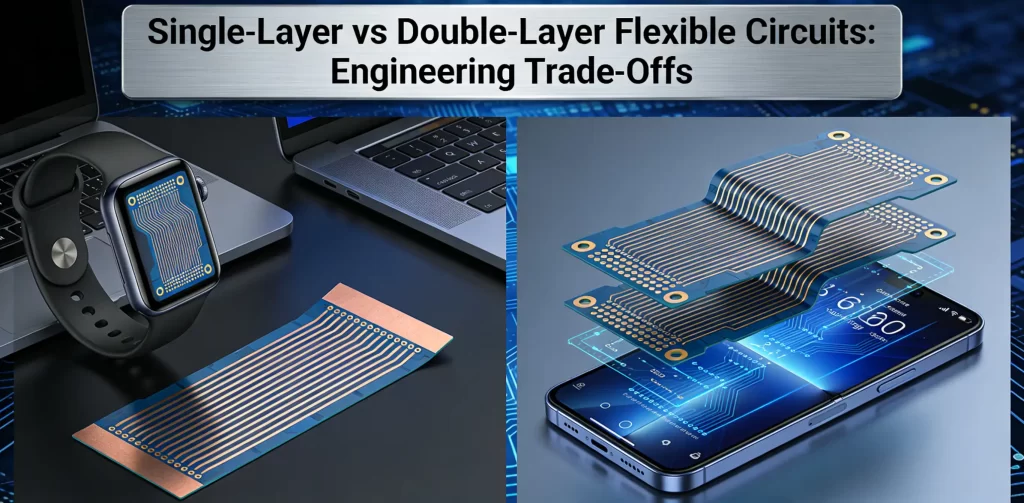
Understanding the Fundamentals of Single-Layer Flexible Circuits
At its core, a Single-Layer flexible circuit consists of one conductive copper layer laminated to a flexible substrate such as polyimide. It is the simplest form of flex PCB construction, yet it remains one of the most widely used configurations in compact electronics.
For a detailed structural overview, see Single-Layer Flexible Circuits.
Structural Characteristics
A typical Single-Layer stack-up includes:
-
One copper conductor layer
-
Polyimide dielectric base
-
Coverlay protection
-
Optional stiffeners
Because there is only one conductive layer, routing must be carefully planned to avoid crossovers. Jumpers or zero-ohm resistors may be required in complex layouts.
Key Advantages of Single-Layer
-
Excellent flexibility due to reduced thickness
-
Lower material complexity
-
Lightweight and compact
-
Ideal for static or low-complexity dynamic applications
Industry data from IPC studies indicates that single-layer flex circuits are commonly used in over 60% of entry-level consumer wearable devices, especially where signal density is low.
However, the simplicity that makes Single-Layer attractive can also introduce limitations when routing complexity increases.
What Defines Double-Layer Flexible Circuits?
When signal density increases or performance demands grow, engineers often transition to Double-Layer Flexible Circuits.
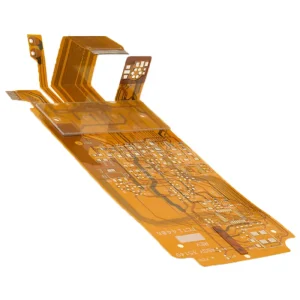
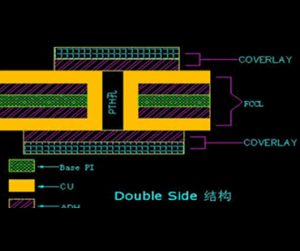
A Double-Layer configuration consists of two copper layers separated by a dielectric substrate, connected through plated through-holes or microvias. This structure significantly enhances routing flexibility and electrical performance.
Explore the technical specifications at Double-Layer Flexible Circuits.
Structural Differences Compared to Single-Layer
-
Two conductive copper layers
-
Interlayer electrical connections (vias)
-
Greater design freedom
-
Potential for controlled impedance
According to global PCB manufacturing data, double-layer flex adoption has grown steadily in automotive electronics and IoT modules over the last five years due to increasing signal complexity.
|
|
|
Data-Driven Comparison: Performance and Engineering Trade-Offs
Let’s move beyond theory and compare measurable engineering factors.
Routing Density
Single-Layer:
-
Limited crossover capability
-
Higher risk of routing congestion
Double-Layer:
-
Enables signal crossover
-
Reduces jumper requirements
-
Improves layout efficiency
In high-density compact devices, double-layer designs can reduce routing area by up to 30%, based on industry case analysis.
Mechanical Flexibility
Single-Layer circuits are generally thinner and therefore slightly more flexible. However, modern adhesive-less double-layer laminates significantly narrow that gap.
Reliability tests conducted in controlled manufacturing environments show:
-
Properly designed Single-Layer circuits withstand thousands of bend cycles
-
Well-optimized Double-Layer Flexible Circuits can achieve comparable cycle endurance when neutral axis and copper balancing are properly engineered
Signal Integrity
Double-layer configurations provide:
-
Better EMI control
-
Reference plane possibilities
-
Controlled impedance routing
These advantages become critical in:
-
Wireless modules
-
Automotive communication systems
-
Industrial IoT data transmission
Application-Based Decision: When to Choose Which?
Application environment often determines the optimal structure.
For real-world use cases, see Top 10 Applications of Single-Layer Flexible Circuits in Electronics.
Best Fit for Single-Layer
-
LED lighting strips
-
Simple wearable sensors
-
Printer cable assemblies
-
Static fold configurations
Best Fit for Double-Layer Flexible Circuits
-
Compact medical diagnostic modules
-
Automotive sensor arrays
-
Multi-signal wearable devices
-
High-speed embedded systems
In internal case studies published by jscircuit, engineers observed that switching from Single-Layer to Double-Layer in a wearable communication module reduced assembly connectors by 40% and improved long-term durability under repetitive motion.

Pain Points Engineers Face — And How to Solve Them
Pain Point 1: Routing Bottlenecks in Compact Designs
Single-Layer layouts can become congested in tight form factors.
Solution:
-
Upgrade to Double-Layer Flexible Circuits for crossover capability
-
Optimize trace width and spacing
-
Apply balanced copper distribution
Pain Point 2: Bend Failure in Dynamic Zones
Improper design leads to copper fatigue.
Solution:
-
Maintain minimum bend radius
-
Avoid vias in dynamic flex regions
-
Use staggered routing techniques
For design optimization techniques, refer to How to Design Single-Layer Flexible Circuits for Compact Devices.
Pain Point 3: EMI Interference in High-Speed Systems
Single-Layer offers limited grounding strategy.
Solution:
-
Implement dual-layer grounding in Double-Layer Flexible Circuits
-
Use shielding films
-
Optimize trace spacing
Manufacturing Expertise Matters More Than Layer Count
The choice between Single-Layer and Double-Layer is not just a design decision—it’s a manufacturing strategy.
An experienced fabrication partner ensures:
-
Accurate layer alignment
-
Controlled impedance accuracy
-
Stable dimensional tolerance
-
Reliable coverlay registration
Companies like jscircuit emphasize early DFM collaboration to prevent costly redesigns and ensure consistent global production quality.
Why Brand Experience and Technical Support Matter
Beyond structural comparison, engineering confidence depends on manufacturer credibility.
The team behind About Us highlights years of PCB fabrication expertise, quality management systems, and international customer collaboration.
In recent industry recognition announcements, jscircuit has been acknowledged for precision flex manufacturing capability and fast technical response time—both critical factors in complex product development cycles.
When design complexity increases, technical consultation becomes a strategic advantage rather than an optional service.
Future Trends: Convergence of Single and Double-Layer Designs
Emerging technologies blur the line between Single-Layer and Double-Layer solutions.
Hybrid Rigid-Flex Integration
Combining rigid sections with flexible interconnects improves system architecture efficiency.
Ultra-Thin Laminates
Advanced materials reduce thickness while preserving electrical performance.
Improved EMI Shielding Films
Allow even Single-Layer solutions to meet higher signal integrity requirements.
However, as device intelligence increases, Double-Layer Flexible Circuits continue to gain adoption in advanced electronics.

Frequently Asked Questions
1. What is the main difference between Single-Layer and Double-Layer Flexible Circuits?
Single-Layer uses one copper conductor layer, while Double-Layer Flexible Circuits use two interconnected copper layers, enabling higher routing density and improved signal management.
2. Are Double-Layer Flexible Circuits less flexible?
Not necessarily. With proper stack-up engineering and adhesive-less construction, they can achieve excellent dynamic bending reliability.
3. When should I upgrade from Single-Layer to Double-Layer?
Upgrade when routing becomes congested, signal integrity requirements increase, or EMI control becomes critical.
4. Do Double-Layer Flexible Circuits improve product durability?
Yes. They can reduce connector usage, simplify assembly, and enhance structural reliability when properly designed.
5. How can I determine the right structure for my project?
Consult experienced flex PCB engineers early in the design phase. You can reach technical support through Contact Us for professional evaluation.
Choosing the Right Layer for the Right Mission
Returning to our opening lab conversation—the failed bend test was not a product flaw. It was a structural decision mismatch.
Single-Layer solutions remain ideal for simple, lightweight, and cost-sensitive applications. Meanwhile, Double-Layer Flexible Circuits unlock higher routing density, better signal control, and expanded design freedom for complex electronics.
The smartest engineering decision is not about choosing the “more advanced” option—it’s about aligning structure with functional demands.
With expert design planning, manufacturing collaboration, and data-driven evaluation, your flex circuit will not just survive mechanical stress—it will power innovation reliably for years to come.