Lab Conversations: Why Double-Layer Flexible Circuits Are the Solution
“Can we double the layers without compromising flexibility?”
The product manager pointed at the prototype spread across the lab bench.
“Our device needs higher routing density and more complex signals, but it still has to survive repeated bending and tight spaces.”
The hardware engineer reviewed the layout.
“By switching to Double-Layer Flexible Circuits, we can achieve more routing in a compact form, maintain signal integrity, and enhance mechanical reliability—all without adding bulk.”
This discussion mirrors challenges engineers face in wearables, automotive electronics, medical devices, and IoT modules. As devices become more compact and multifunctional, traditional single-layer or rigid PCBs often fall short in balancing complexity, flexibility, and durability.
In this article, we explore the structure, advantages, and design principles of Double-Layer Flexible Circuits, supported by scientific research, engineering case studies, and insights from JSCircuit, a leading manufacturer serving global electronics innovators.
Understanding Double-Layer Flexible Circuit Structure
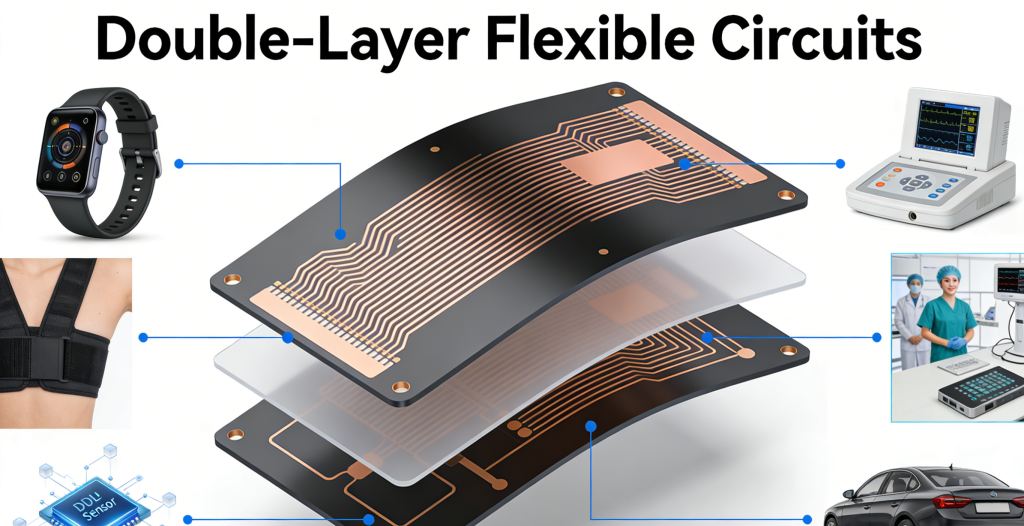
Double-layer flexible circuits consist of two conductive layers separated by a thin insulating layer, typically made of polyimide. This design allows:
-
Increased signal routing in compact spaces
-
Reduction in overall device size
-
Improved reliability due to fewer connectors
As highlighted on JSCircuit About Us, the company emphasizes precision manufacturing and material quality to ensure that double-layer circuits meet high-speed and high-density requirements.
Key Structural Components:
-
Top and bottom copper layers
-
Polyimide or flexible dielectric material
-
Adhesive and protective coverlay
-
Vias connecting both layers for electrical continuity
Advantages of Double-Layer Flexible Circuits
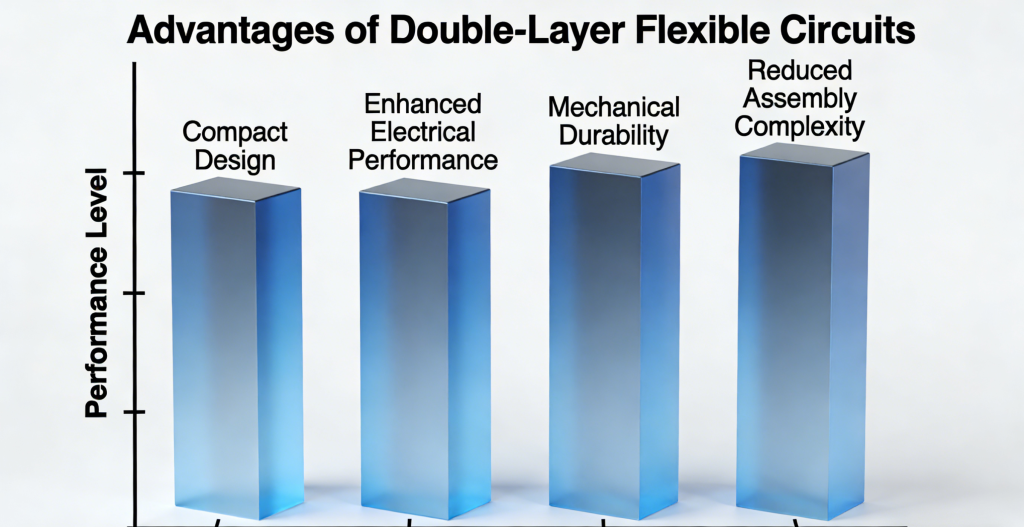
Double-layer flexible circuits offer multiple advantages over single-layer or rigid PCBs:
-
Compact Design: Multiple traces can fit in limited spaces
-
Enhanced Electrical Performance: Controlled impedance allows high-speed signal integrity
-
Mechanical Durability: Withstands repeated bending and vibration
-
Reduced Assembly Complexity: Less reliance on connectors and wire harnesses
For detailed manufacturing strategies, see JSCircuit Contact Page.
Applications Across Industries
1. Wearable Electronics
Smartwatches, fitness bands, and health monitors benefit from the compactness and flexibility of double-layer circuits. Engineers can route more signals in the same area while maintaining comfort and reliability.
2. Medical Devices
Portable medical monitors, ECG machines, and infusion devices require reliable signal transmission in compact housings. Double-layer flexible circuits simplify design while ensuring patient safety and device durability.
For practical applications, see JSCircuit Services.
3. Automotive Electronics
Sensors, cameras, and ADAS modules require robust, vibration-resistant flexible circuits. Double-layer designs support higher complexity without adding bulk, making them ideal for vehicle interiors and tight spaces.
4. IoT Modules
Compact IoT devices integrate multiple sensors, wireless modules, and antenna systems. Double-layer flexible circuits help reduce size, enhance signal integrity, and simplify assembly.
5. Consumer Electronics
Smartphones, tablets, and portable cameras utilize double-layer circuits to maintain thin form factors while supporting multiple high-speed traces.
For more examples, see JSCircuit Application Page.
Design Considerations and Best Practices
To maximize performance and reliability, engineers should focus on:
-
Bend Radius: Follow recommended minimum bend radius to prevent failure
-
Material Selection: Polyimide or flexible laminates with stable thermal and mechanical properties
-
Trace Routing: Minimize crosstalk and maintain controlled impedance
-
Layer Alignment: Precise alignment of top and bottom layers for via connectivity
-
Early Manufacturer Collaboration: Engage with your PCB supplier to ensure manufacturability
Case Study: Wearable Health Monitor
A wearable ECG device required routing 50 signals in a 2 mm thickness. By switching to a double-layer flexible circuit from JSCircuit, engineers achieved:
-
30% reduction in thickness
-
Reliable operation over 10,000 flex cycles
-
Simplified assembly, reducing potential connector failures
This example highlights how proper design and material selection enhance device reliability.

Frequently Asked Questions
What are Double-Layer Flexible Circuits used for?
They are used in wearables, medical devices, automotive sensors, IoT devices, and compact consumer electronics requiring higher routing density.
How many flex cycles can they withstand?
Thousands of bending cycles without electrical failure when properly designed.
Can they handle high-speed signals?
Yes, with impedance-controlled layouts and optimized grounding strategies.
Do double-layer circuits reduce assembly complexity?
Yes. Fewer connectors and integrated routing simplify assembly and improve manufacturability.
When should the manufacturer be involved in the design process?
Ideally during early layout planning to ensure material compatibility, tolerance control, and manufacturability.
As electronics continue to shrink while demanding higher performance, traditional rigid and single-layer boards increasingly struggle to meet modern design requirements. Double-Layer Flexible Circuits offer a powerful solution, providing higher routing density, improved signal integrity, and mechanical resilience—all within compact, bendable forms. By integrating two conductive layers separated by insulating materials, these circuits allow engineers to manage complex signal layouts without adding bulk or compromising flexibility.
Industries ranging from wearables and medical devices to automotive systems and IoT modules benefit from their ability to reduce connectors, simplify assembly, and endure thousands of flex cycles. Scientific studies and real-world cases from JSCircuit demonstrate measurable improvements in durability, performance, and manufacturability. Proper design practices, such as careful material selection, controlled impedance layouts, and early manufacturer collaboration, are crucial to maximizing their advantages. Ultimately,
Double-Layer Flexible Circuits bridge the gap between compact form factors and sophisticated electronic functionality, enabling engineers to push the limits of miniaturization while ensuring reliability, signal stability, and cost-effective production. For innovators seeking high-performance, space-efficient designs, these circuits represent a strategic choice that aligns with both engineering demands and market expectations.