Key Project Overview: Advanced CCS FPC Manufacturing Solutions
Quick Summary: This technical case study analyzes the engineering and high-precision fabrication of a multi-layer CCS FPC optimized for next-generation battery pack architectures. Acting as the “neural network” of the battery management system (BMS), this 0.1mm-0.3mm ultra-thin component utilizes advanced high-density interconnect (HDI) routing, copper-filled thermal microvias, and rolled-annealed (RA) copper foils to deliver absolute reliability. As a premier flexible printed circuit board factory and full-service PCB manufacturer, we provide specialized FPC fabrication solutions that fulfill rigorous IPC-A-610 Class 3 automotive reliability benchmarks.
Understanding CCS FPC: The Core Electrical Neural Network for Next-Gen Battery Pack Design
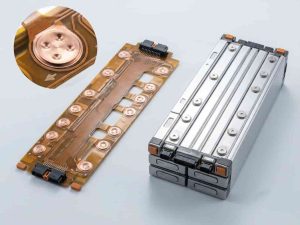
In the rapidly evolving electric vehicle (EV) and energy storage system (ESS) markets, the efficiency of battery pack assembly defines structural reliability. The CCS (Cells Contact System) FPC has emerged as the critical baseline architecture for battery cell monitoring, integrating voltage sensing, temperature tracking (NTC solder joints), and overcurrent fuse protection into a single integrated busbar component. Historically, battery modules relied on traditional wire harnesses that required manual assembly, added dead weight, and were highly prone to connection failures under continuous vehicle vibration.
Transitioning to an integrated multi-layer FPC solves these manufacturing limitations. By eliminating mechanical connectors and wire bundles, the CCS module allows for automated robotic pick-and-place and high-speed laser welding directly onto copper or aluminum cell busbars. This shift slashes internal space consumption within the battery enclosure by up to 75%, directly maximizing volumetric energy density while providing cleaner, automated assembly workflows. For deeper insights into advanced board architecture optimizations, explore our dedicated JS Circuit Blog.
As a global high-precision FPC manufacturer and trusted flexible printed circuit board supplier, we construct these advanced CCS paths under strict zero-defect parameters. This technical breakdown explores how premium substrate execution and high-frequency layout techniques address the demanding power and thermal profiles of modern green energy platforms.
Substrate Materials: Rolled-Annealed Copper and Thermal Runaway Defenses
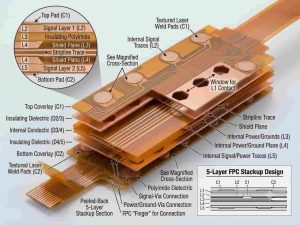
The operating environment inside a high-voltage battery pack subjects internal circuitry to severe mechanical and thermal strains. Standard electro-deposited (ED) copper foils possess a vertical, columnar crystal structure that fractures easily under repetitive vibration or thermal contraction. To ensure long-term physical survivability, our specialized FPC manufacturing pipeline exclusively utilizes Rolled-Annealed (RA) copper foils bonded to high-durability polyimide (PI) base films. The horizontally elongated grain structure of RA copper allows the internal traces to endure over 10 million dynamic flex and expansion cycles without resistance degradation.
Furthermore, thermal dissipation is vital to preserve sensor calibration and prevent hazardous thermal runaway events. Modern CCS units frequently integrate localized flash microcontrollers and high-resolution data loggers at the module edge to log continuous cell status. To keep these fine-pitch components running within safe thermal windows, the FPC features a dense array of copper-filled thermal microvias. These microvias draw structural heat away from the component pads and distribute it evenly across the outer ground layers, preventing localized thermal stress zones.
HDI Structural Engineering and Advanced Shielding Topologies
To simultaneously route high-voltage monitoring lines and ultra-fast data channels within a single flexible outline, advanced high-density interconnect (HDI) principles must be deployed. By leveraging laser-drilled blind and buried microvias, fine line widths, and tight spacing, our engineering teams can easily accommodate fine pitch packaging architectures (such as miniaturized sensor ICs and communication transceivers) directly on the flexible strip.
The proximity of high-current busbars, inverter switching networks, and onboard charging systems exposes data lines to immense electromagnetic interference (EMI). To maintain high signal integrity, the multi-layer FPC utilizes a highly engineered stripline topology. Sensitive high-frequency signal traces are routed on internal layers, completely sandwiched between solid or hatched copper ground reference planes on the outer layers. This embedded Faraday cage blocks external electrical noise, yielding an EMI attenuation score exceeding 70 dB to prevent data corruption.
Critical Engineering Parameters
| Technical Parameter | CCS FPC Specification | Industrial Metrology / EV Impact |
|---|---|---|
| Conductor Material | Rolled-Annealed (RA) Copper Foil | Eliminates trace cracking caused by severe vehicle vibrations. |
| Interconnect Level | HDI with Laser Microvias | Enables high-density routing for fine-pitch BGA and sensor packaging. |
| Shielding Efficiency | Stripline Shielding Topology | Provides >70 dB attenuation against high-voltage inverter EMI. |
| Surface Contact Finish | ENIG (RoHS Compliant) | Delivers flat, corrosion-resistant pads for optimal ultrasonic/laser welding. |
Quality Rigor: IPC-A-610 Class 3 Production Validation
Because a failure in a vehicle’s battery management system threatens consumer safety, CCS module production demands strict manufacturing validation. Beyond automated optical testing (AOI) for line definition, our factory applies automated 3D X-ray laminography. This guarantees perfect, void-free plating inside high-aspect-ratio stacked microvias and exact layer-to-layer registration across the multi-layer flexible matrix.
Our fabrication facilities and advanced PCBA processing services operate in strict accordance with IPC-A-610 Class 3 guidelines. This standard is mandatory for high-performance electronic products where continuous uptime is vital and equipment malfunction cannot be tolerated. Combined with a premium Electroless Nickel Immersion Gold (ENIG) surface finish, the FPC delivers flat, highly solderable pads that ensure reliable joint strength during high-speed surface-mount component placement.
Strategic Insights: Scaling the Future of Intelligent E-Mobility
Expert Engineering Summary: High-Reliability Power & Data Integration
The Industrial Challenge: Merging cell tracking with dense localized hardware creates deep thermal and electronic cross-talk challenges. Traditional wire configurations increase overall pack weight, lack mechanical scalability, and create a high risk of manual routing faults. Consolidating all communication channels into a pure multi-layer FPC streamlines space requirements by up to 75% while completely removing failure-prone mechanical terminals.
Advanced Manufacturing Execution: Achieving reliable 90-ohm differential impedance control along highly flexible thin films requires expert execution of HDI methodologies. Selecting rolled-annealed foils ensures the critical data lanes remain stable under physical strain, providing a robust, high-volume data highway directly embedded within the structural cell architecture.
Expert Conclusion: Modern energy platforms demand the flawless co-existence of power distribution and high-frequency telemetry. This case study demonstrates that a pure custom multilayer FPC turnkey solution offers the mechanical durability and electrical performance required to drive the next generation of smart manufacturing.
Frequently Asked Questions
1. What is a CCS FPC and how does it advance battery pack assembly?
A CCS (Cells Contact System) FPC integrates multiple voltage and temperature sensing lines into a single flexible circuit layout. It replaces bulky wire harnesses, allows for automated laser welding, and slashes total internal space consumption by up to 75%.
2. Why is an HDI layout necessary for modern multi-layer FPCs?
HDI (High-Density Interconnect) layout incorporates laser-drilled microvias and micro-fine lines. This technology allows dense routing of complex telemetry paths within tight outlines, accommodating advanced fine-pitch packaging component profiles.
3. What makes rolled-annealed copper critical for automotive-grade flexible boards?
Unlike electro-deposited copper, rolled-annealed copper undergoes intense mechanical rolling that flattens its crystal grains horizontally. This composition delivers superior elasticity, allowing the FPC to survive more than 10 million extreme dynamic vibration cycles without cracking.
4. How do multi-layer FPCs isolate delicate data traces from cell electrical noise?
They implement a strict stripline topology where high-speed differential pairs are routed on internal layers, vertically enclosed between solid copper ground planes that function as a continuous Faraday cage to block severe workshop and battery EMI.
5. Does your flexible printed circuit board factory fulfill IPC Class 3 standards?
Yes. Our fabrication and advanced assembly operations strictly adhere to IPC-A-610 Class 3 standards, utilizing high-resolution 3D X-ray testing and automated optical inspection to guarantee zero defects for mission-critical hardware applications.
References
- ISO 26262-5: Road vehicles — Functional safety — Part 5: Product development at the hardware level.
- IPC-A-610H: Acceptability of Electronic Assemblies, IPC International Standard (2020).
- IPC-2223E: Sectional Design Standard for Flexible Printed Boards (2020).
- IEEE Transactions on Components, Packaging and Manufacturing Technology: Advanced Signal and Thermal Integrity Analysis in Multi-layer Flexible Substrates.
- SAE International: Electrification Interconnect Optimization using High-Density Flexible Printed Circuits (2023).
- RoHS 3 Directive (2015/863/EU): Restriction of Hazardous Substances in Multi-layer Assemblies.
- IPC-6013E: Qualification and Performance Specification for Flexible Printed Boards (Class 3 High-Reliability Criteria).
- Journal of Power Sources: Structural Reliability of Cell Contact Systems in High-Capacity Lithium-Ion Battery Packs (2024).