
Key Project Overview: 2-Layer FPC Manufacturing Solutions
Quick Summary: This technical case study examines the high-precision fabrication of a 2-layer FPC designed for industrial 3D scanning measurement devices. By optimizing high-density interconnect (HDI) routing, incorporating fine pitch packaging configurations, and utilizing rolled-annealed (RA) copper foils, this architecture ensures absolute signal integrity during automated piston cylinder bore inspection cycles. As a leading flexible printed circuit board factory and turnkey PCB manufacturer, we deliver advanced FPC fabrication solutions that fulfill strict IPC-A-610 Class 3 reliability standards for the global non-contact metrology market.
Advanced 3D Scanning Measurement: Optimizing Industrial Inspection with 2-Layer FPC Architecture
In modern automated assembly lines and automotive powertrain manufacturing, component dimensional control leaves no room for error. Traditionally, quality inspection relied on physical coordinate measuring machines (CMMs) or mechanical plug gauges. However, these touch-probe methods introduce mechanical blind spots, increase cycle-time penalties, and risk surface deformation on high-precision parts.
To achieve 100% data density at inline production speeds, the manufacturing sector is rapidly shifting toward non-contact, high-frequency blue laser industrial 3D scanning measurement systems. To fit these advanced optoelectronic assemblies into compact, down-bore inspection probes, equipment designers must move away from heavy internal wire harnesses. Implementing a custom 2-layer FPC allows the scanning probe to enter restricted cylindrical cavities smoothly while maintaining uninterrupted high-speed data acquisition on the factory floor.
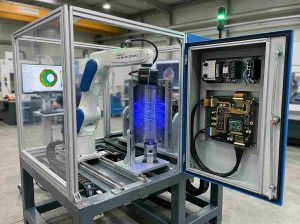
As a specialized high-precision FPC manufacturer and an established flexible printed circuit board supplier, we recognize that down-bore automated probes operate under a “zero-failure” paradigm. This case study details the material properties, signal integrity layouts, and quality controls required for high-tier FPC fabrication and assembly.
Substrate Science: Rolled-Annealed Copper and Thermal Management
Material selection is a critical factor in high-reliability FPC manufacturing. Standard electro-deposited (ED) copper foils have a vertical, columnar crystal grain structure that is prone to micro-cracking under repetitive bending or rotational strain. This project utilizes Rolled-Annealed (RA) copper foils laminated to a polyimide (PI) base. During automated piston cylinder bore inspection, the flexible board must bend and twist within tight mechanical housings. The elongated horizontal grain structure of RA copper allows the board to withstand over 10 million dynamic flex cycles without experiencing trace fractures or localized resistance spikes.
Thermal management is also critical to eliminate measurement drift during non-contact metrology routines. The high-power laser diodes contained within the scanner head generate significant heat, which can cause volumetric expansion and compromise calibration. The 2-layer layout features an optimized matrix of copper-filled thermal microvias. These microvias act as thermal conduits through the polyimide film, quickly drawing heat away from sensitive sensor ICs and transferring it to the scanner’s external metallic enclosure to maintain a stable 3D point cloud calibration baseline.
HDI Layout Design and Advanced Stripline Shielding
Transmitting high-resolution point-cloud data from the CMOS image sensor requires a data throughput capacity up to 12 Gbps over MIPI CSI-2 and USB 3.1 channels. To achieve this within a compact footprint, the circuit layout implements high-density interconnect (HDI) principles, including laser-drilled blind and buried microvias, fine line widths, and precise trace spaces.
Industrial environments expose internal circuitry to high electromagnetic interference (EMI) from equipment like CNC machinery and robotic welders. To ensure robust signal integrity, the 2-layer stackup utilizes an advanced stripline topology. High-speed differential pairs are routed exclusively on Layer 2, vertically sandwiched between solid copper ground reference planes on Layer 1 and adjacent shields. This internal Faraday cage layout achieves an EMI attenuation score exceeding 70 dB, preventing data packet corruption and preserving high-precision inspection performance.
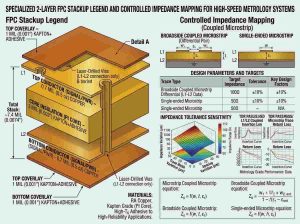 Specialized 2-Layer FPC Stackup Legend and Controlled Impedance Mapping for High-Speed Metrology Systems.
Critical Engineering Parameters
| Technical Feature | FPC Project Specification | Industrial Metrology Impact |
|---|---|---|
| Base Substrate Material | Polyimide (PI) Core with RA Copper | Provides structural endurance against multi-axis mechanical strain. |
| Shielding Configuration | Embedded Stripline Layout (Layer 1/2 GND) | Blocks factory floor EMI with an attenuation rating >70dB. |
| Interconnect Technology | HDI Layout with Laser Microvias | Supports dense, fine-pitch BGA packaging inside compact probe shells. |
| Surface Finish Option | ENIG (RoHS Compliant) | Delivers a flat bonding surface for reliable, low-loss component assembly. |
Quality Assurance and Advanced PCBA Processing
Manufacturing high-density double-sided flexible circuits requires strict process validation. Beyond standard Automated Optical Inspection (AOI) to verify fine trace structures, our flexible printed circuit board factory applies high-resolution 3D X-ray laminography. This testing ensures void-free plating in stacked microvias and precise interlayer registration across both flexible layers.
Our complete fabrication workflow and advanced PCBA processing services strictly comply with IPC-A-610 Class 3 guidelines. This performance tier is mandatory for mission-critical industrial electronics where continuous operation must be guaranteed and equipment downtime is not acceptable. Additionally, all assemblies are manufactured with a RoHS-compliant Electroless Nickel Immersion Gold (ENIG) surface finish, providing flat, durable pads for fine-pitch component mounting.
Strategic Insights: Accelerating Industry 4.0 Deployment
Expert Engineering Summary: High-Reliability Industrial Metrology Electronics
The Technical Challenge: In down-bore automated metrology, trace cracking or connector unseating caused by mechanical movement will halt the entire automated inspection sequence. Traditional wire assemblies introduce unnecessary bulk and failure-prone connectors. Transitioning to a pure 2-layer FPC streamlines internal routing, eliminating standard wire-to-board connectors and reducing the internal electronics footprint by up to 75%.
Advanced Manufacturing Alignment: Succeeding with high-density flexible layouts requires precise execution of HDI principles. By maintaining tight 90-ohm differential impedance tolerances on internal signal traces, this architecture supports low-latency point-cloud data streaming. This structural reliability is reinforced by selecting rolled-annealed copper foils, which protect critical circuit lines from repetitive mechanical fatigue.
Expert Conclusion: Inline metrology platforms require compact electronic packaging combined with effective thermal and electromagnetic control. This 2-layer case study confirms that an integrated custom double-sided FPC turnkey solution provides the structural integrity needed to achieve consistent, long-term operational up-time on the shop floor.
Frequently Asked Questions
1. Why is a 2-layer FPC required for industrial 3D scanning measurement probes?
It provides double-sided stripline shielding and dense routing within an ultra-thin, connector-less profile, supporting 12 Gbps data transmission speeds from narrow spaces like an automotive cylinder bore.
2. How does an HDI layout benefit high-precision inspection electronics?
HDI technology integrates laser-drilled microvias and tight trace spaces, enabling engineers to route high-frequency signal channels through minimal space and accommodate fine-pitch BGA component packaging.
3. What makes rolled-annealed copper superior for double-sided flexible circuit boards?
Rolled-annealed copper features a horizontally elongated crystal grain structure that offers excellent elasticity, allowing the circuit to endure over 10 million flex cycles without fatigue-induced trace cracking.
4. How does the 2-layer FPC configuration manage electromagnetic interference (EMI)?
The board uses an internal stripline shielding topology where sensitive high-speed signal traces on Layer 2 are vertically enclosed between solid copper ground reference planes on Layer 1 and adjacent layers, reducing noise by more than 70 dB.
5. Does your flexible printed circuit board factory comply with IPC Class 3?
Yes. Our fabrication and advanced assembly processes adhere to IPC-A-610 Class 3 specifications, utilizing automated optical inspection and 3D X-ray testing to guarantee zero-defect manufacturing reliability.
References
- ISO 10360-8: Geometrical product specifications (GPS) — Acceptance and reverification tests for coordinate measuring systems (CMS) — Part 8: CMMs with optical distance sensors.
- IPC-A-610H: Acceptability of Electronic Assemblies, IPC International Standard (2020).
- IPC-2223E: Sectional Design Standard for Flexible Printed Boards (2020).
- IEEE Transactions on Electromagnetic Compatibility: High-Density Signal Integrity Analysis in Flexible Polyimide Substrates.
- Society of Photo-Optical Instrumentation Engineers (SPIE): High-Speed Optical Triangulation Architectures for Confined Space Inspection (2022).
- Journal of Manufacturing Systems and Core Technology Metrology: Real-time Closed-loop Feedback Networks via High-Density Point Clouds (2024).
- RoHS 3 Directive (2015/863/EU): Restrictions on Hazardous Substances in Electronic Assemblies.
- IPC-6013E: Qualification and Performance Specification for Flexible/Rigid-Flex Printed Boards (Relevant for Flexible Board Class 3 Compliance).